

basement dehumidifier

How to Dehumidify a Room: 10 Effective Ways to Reduce Humidity

How to Dehumidify a Room: 10 Effective Ways to Reduce Humidity
Learning how to dehumidify a room starts with one simple idea: control where the moisture comes from, then remove the excess moisture from the air. A humid room can feel stuffy, develop condensation, and create conditions that support mold growth. Some situations can be handled with better ventilation and daily habits. Others need a dehumidifier for steady moisture control. Here are 10 practical ways to reduce humidity in a room, plus tips for drying out a humid room quickly and keeping moisture from coming back.

First, Check Why the Room Feels Humid

Before trying to lower humidity, find the source. Bathrooms and kitchens naturally produce moisture from showers, cooking, and boiling water. Indoor laundry can add more water vapor to the air. Poor ventilation, plumbing leaks, wet carpets, and basement moisture can also keep a room damp.
A hygrometer can help you check the actual relative humidity (RH) instead of relying only on how the room feels. It is useful when deciding whether your current solution is working.

10 Effective Ways to Dehumidify a Room

  1. Use a Dehumidifier

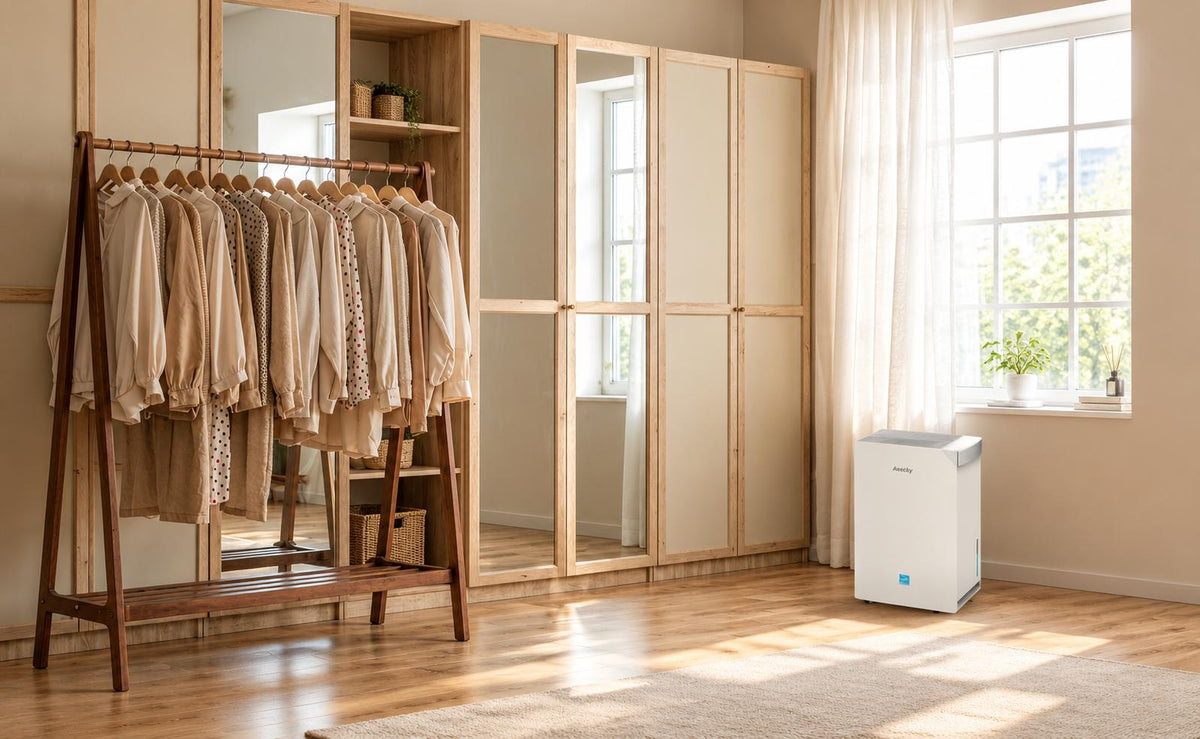
A Dehumidifier is one of the most direct ways to remove excess moisture from indoor air. It draws humid air into the unit, removes water from the air, and returns drier air to the room.
This is especially useful when humidity stays high for long periods or when ventilation alone is not enough. Look for a unit with enough capacity for the room and consider how damp the space is, not just its floor area.
For larger rooms or areas with persistent moisture, AEOCKY offers several models designed for different room sizes. The AEOCKY Rhea Dehumidifier is designed for spaces up to 4,500 square feet. The AEOCKY Leo 001 Max is another high-capacity option listed at up to 80 pints and 4,500 square feet.
For ongoing humidity control, capacity matters. So does proper placement. Keep the unit where air can circulate freely, and maintain its filter and water collection system according to the manufacturer's instructions.
  1. Run Your Air Conditioner

Your air conditioner can also remove some moisture while cooling the room. Warm indoor air passes over a cold coil, causing water vapor to condense and drain away.
AC can be useful during hot, humid weather, especially when you need both cooling and some moisture removal. However, an air conditioner is not always a substitute for a dedicated Dehumidifier, particularly when the room remains damp after the temperature has already dropped.
  1. Improve Airflow With Fans

Fans do not normally remove moisture from the air. They move air around.
Still, better airflow can help prevent humid air from sitting in corners, behind furniture, or near damp surfaces. A ceiling fan or portable fan can also help distribute conditioned or dehumidified air more evenly throughout the room.
Use fans as part of a larger humidity-control plan rather than as the only solution.
  1. Turn On Bathroom and Kitchen Exhaust Fans

Bathrooms and kitchens are two major indoor sources of moisture.
Run the bathroom exhaust fan while showering and keep it running afterward for a while. In the kitchen, use the range hood when boiling water or cooking foods that create a lot of steam.
The goal is simple: remove moisture before it spreads into other rooms.
  1. Ventilate When Outdoor Air Is Drier

Opening windows can help reduce humidity without a dehumidifier, but only when outdoor air is actually drier than indoor air.
On a dry day, cross-ventilation can quickly replace humid indoor air with drier outdoor air. On a muggy day, however, opening windows may bring more moisture inside.
If possible, check outdoor humidity before relying on ventilation as your main strategy.
  1. Stop Drying Wet Clothes Indoors

Wet clothes release water into the surrounding air as they dry. If you regularly hang laundry inside a small or poorly ventilated room, indoor humidity can rise quickly.
Dry clothes outdoors when practical, or use a dryer with proper ventilation. If indoor drying is unavoidable, increase airflow and consider running a Dehumidifier nearby.
  1. Reduce Steam From Cooking and Showers

You can also reduce humidity by producing less moisture in the first place.
Cover pots while cooking, use lids when appropriate, and avoid leaving boiling water uncovered for long periods. Shorter showers can reduce the amount of steam released into the bathroom.
Dry wet towels and other damp items instead of leaving them in the room. Small changes like these can make a noticeable difference when moisture is being added every day.
  1. Fix Leaks, Standing Water, and Damp Materials

If a room keeps becoming humid despite your best efforts, look for a water source.
Check for leaking pipes, roof leaks, damp walls, wet carpets, standing water, or moisture entering from a basement or crawl space. A Dehumidifier can remove moisture from the air, but it cannot repair a leak.
Fixing the source should come first. Otherwise, the humidity problem is likely to return.
  1. Use Moisture Absorbers in Small Enclosed Spaces

Moisture absorbers can be useful in closets, cabinets, storage areas, and other small enclosed spaces.
They work by capturing moisture rather than actively circulating and processing large amounts of air. That makes them less suitable for a large, consistently humid room.
For a bedroom, basement, or open living area with persistent humidity, an electric Dehumidifier is generally a more practical approach.
  1. Keep the Room Dry After Humidity Drops

Getting humidity down is only half the job. You also need to prevent it from climbing again.
Keep wet items out of the room, wipe away condensation, use exhaust fans when producing steam, and maintain your HVAC system. Check humidity from time to time with a hygrometer, especially during humid seasons.
A consistent routine works better than waiting until the room feels damp again.

How to Dehumidify a Room Quickly

If you need to dehumidify a room quickly, start with the moisture source.
  1. Stop the activity creating excess moisture.
  2. Turn on bathroom or kitchen exhaust fans if appropriate.
  3. Improve airflow with a fan.
  4. Run the air conditioner when cooling is needed.
  5. Use a Dehumidifier for direct and continuous moisture removal.
  6. Monitor humidity to see whether the level is actually falling.
For larger areas, the AEOCKY Leo Dehumidifier is listed for spaces up to 4,500 square feet with a maximum capacity of 80 pints. For smaller spaces, the AEOCKY Arion Dehumidifier is listed for up to 2,800 square feet with a maximum capacity of 40 pints.

Can a Dehumidifier Prevent Mold?

A Dehumidifier can help reduce the moisture conditions that allow mold to grow, but it cannot guarantee that mold will never appear.
Keeping indoor humidity under control can make the environment less favorable for mold. But if you already have visible mold, a persistent leak, or water damage, lowering humidity alone does not solve the underlying problem.
Think of a Dehumidifier as part of moisture control, not a replacement for cleaning mold or repairing water intrusion.

When You Need More Than a Dehumidifier

If humidity keeps returning after you have improved ventilation and used a Dehumidifier, look for an ongoing moisture source.
Persistent condensation, musty odors, visible mold, wet walls, or recurring water damage can point to a larger problem. In these cases, repairing the source of the moisture is more important than simply running the Dehumidifier longer.
When choosing an energy-efficient model, you can also explore the AEOCKY Energy Star Series to compare the brand's available models.

Common Mistakes When Trying to Reduce Room Humidity

A few common mistakes can make humidity control less effective:
  • Opening windows on a humid day: Outdoor air may add more moisture.
  • Using a fan by itself: Fans move air but do not normally remove water vapor.
  • Ignoring leaks: A continuing water source can overwhelm other humidity-control methods.
  • Choosing a unit based only on room size: Humidity level and room conditions also matter.
  • Skipping maintenance: Dirty filters or a poorly maintained unit can reduce performance.

Final Thoughts

The best way to dry out a humid room is to deal with moisture at its source and then remove the excess water from the air. Better ventilation, exhaust fans, air conditioning, and daily habits can help with mild or temporary humidity. When moisture remains high, a Dehumidifier provides a more direct way to control indoor humidity. Keep monitoring the room after it dries out, and address leaks or water damage instead of treating only the symptoms. A simple moisture-control routine can keep a room more comfortable and reduce the conditions that encourage mold growth.
 

Reading next

What Features Should You Look for in a Dehumidifier?

Leave a comment

This site is protected by hCaptcha and the hCaptcha Privacy Policy and Terms of Service apply.

How to Dehumidify a Room: 10 Effective Ways to Reduce Humidity

Learning how to dehumidify a room starts with one simple idea: control where the moisture comes from, then remove the excess moisture from the air. A humid room can feel stuffy, develop condensation, and create conditions that support mold growth. Some situations can be handled with better ventilation and daily habits. Others need a dehumidifier for steady moisture control. Here are 10 practical ways to reduce humidity in a room, plus tips for drying out a humid room quickly and keeping moisture from coming back.

First, Check Why the Room Feels Humid

Before trying to lower humidity, find the source. Bathrooms and kitchens naturally produce moisture from showers, cooking, and boiling water. Indoor laundry can add more water vapor to the air. Poor ventilation, plumbing leaks, wet carpets, and basement moisture can also keep a room damp.
A hygrometer can help you check the actual relative humidity (RH) instead of relying only on how the room feels. It is useful when deciding whether your current solution is working.

10 Effective Ways to Dehumidify a Room

  1. Use a Dehumidifier

A Dehumidifier is one of the most direct ways to remove excess moisture from indoor air. It draws humid air into the unit, removes water from the air, and returns drier air to the room.
This is especially useful when humidity stays high for long periods or when ventilation alone is not enough. Look for a unit with enough capacity for the room and consider how damp the space is, not just its floor area.
For larger rooms or areas with persistent moisture, AEOCKY offers several models designed for different room sizes. The AEOCKY Rhea Dehumidifier is designed for spaces up to 4,500 square feet. The AEOCKY Leo 001 Max is another high-capacity option listed at up to 80 pints and 4,500 square feet.
For ongoing humidity control, capacity matters. So does proper placement. Keep the unit where air can circulate freely, and maintain its filter and water collection system according to the manufacturer's instructions.
  1. Run Your Air Conditioner

Your air conditioner can also remove some moisture while cooling the room. Warm indoor air passes over a cold coil, causing water vapor to condense and drain away.
AC can be useful during hot, humid weather, especially when you need both cooling and some moisture removal. However, an air conditioner is not always a substitute for a dedicated Dehumidifier, particularly when the room remains damp after the temperature has already dropped.
  1. Improve Airflow With Fans

Fans do not normally remove moisture from the air. They move air around.
Still, better airflow can help prevent humid air from sitting in corners, behind furniture, or near damp surfaces. A ceiling fan or portable fan can also help distribute conditioned or dehumidified air more evenly throughout the room.
Use fans as part of a larger humidity-control plan rather than as the only solution.
  1. Turn On Bathroom and Kitchen Exhaust Fans

Bathrooms and kitchens are two major indoor sources of moisture.
Run the bathroom exhaust fan while showering and keep it running afterward for a while. In the kitchen, use the range hood when boiling water or cooking foods that create a lot of steam.
The goal is simple: remove moisture before it spreads into other rooms.
  1. Ventilate When Outdoor Air Is Drier

Opening windows can help reduce humidity without a dehumidifier, but only when outdoor air is actually drier than indoor air.
On a dry day, cross-ventilation can quickly replace humid indoor air with drier outdoor air. On a muggy day, however, opening windows may bring more moisture inside.
If possible, check outdoor humidity before relying on ventilation as your main strategy.
  1. Stop Drying Wet Clothes Indoors

Wet clothes release water into the surrounding air as they dry. If you regularly hang laundry inside a small or poorly ventilated room, indoor humidity can rise quickly.
Dry clothes outdoors when practical, or use a dryer with proper ventilation. If indoor drying is unavoidable, increase airflow and consider running a Dehumidifier nearby.
  1. Reduce Steam From Cooking and Showers

You can also reduce humidity by producing less moisture in the first place.
Cover pots while cooking, use lids when appropriate, and avoid leaving boiling water uncovered for long periods. Shorter showers can reduce the amount of steam released into the bathroom.
Dry wet towels and other damp items instead of leaving them in the room. Small changes like these can make a noticeable difference when moisture is being added every day.
  1. Fix Leaks, Standing Water, and Damp Materials

If a room keeps becoming humid despite your best efforts, look for a water source.
Check for leaking pipes, roof leaks, damp walls, wet carpets, standing water, or moisture entering from a basement or crawl space. A Dehumidifier can remove moisture from the air, but it cannot repair a leak.
Fixing the source should come first. Otherwise, the humidity problem is likely to return.
  1. Use Moisture Absorbers in Small Enclosed Spaces

Moisture absorbers can be useful in closets, cabinets, storage areas, and other small enclosed spaces.
They work by capturing moisture rather than actively circulating and processing large amounts of air. That makes them less suitable for a large, consistently humid room.
For a bedroom, basement, or open living area with persistent humidity, an electric Dehumidifier is generally a more practical approach.
  1. Keep the Room Dry After Humidity Drops

Getting humidity down is only half the job. You also need to prevent it from climbing again.
Keep wet items out of the room, wipe away condensation, use exhaust fans when producing steam, and maintain your HVAC system. Check humidity from time to time with a hygrometer, especially during humid seasons.
A consistent routine works better than waiting until the room feels damp again.

How to Dehumidify a Room Quickly

If you need to dehumidify a room quickly, start with the moisture source.
  1. Stop the activity creating excess moisture.
  2. Turn on bathroom or kitchen exhaust fans if appropriate.
  3. Improve airflow with a fan.
  4. Run the air conditioner when cooling is needed.
  5. Use a Dehumidifier for direct and continuous moisture removal.
  6. Monitor humidity to see whether the level is actually falling.
For larger areas, the AEOCKY Leo Dehumidifier is listed for spaces up to 4,500 square feet with a maximum capacity of 80 pints. For smaller spaces, the AEOCKY Arion Dehumidifier is listed for up to 2,800 square feet with a maximum capacity of 40 pints.

Can a Dehumidifier Prevent Mold?

A Dehumidifier can help reduce the moisture conditions that allow mold to grow, but it cannot guarantee that mold will never appear.
Keeping indoor humidity under control can make the environment less favorable for mold. But if you already have visible mold, a persistent leak, or water damage, lowering humidity alone does not solve the underlying problem.
Think of a Dehumidifier as part of moisture control, not a replacement for cleaning mold or repairing water intrusion.

When You Need More Than a Dehumidifier

If humidity keeps returning after you have improved ventilation and used a Dehumidifier, look for an ongoing moisture source.
Persistent condensation, musty odors, visible mold, wet walls, or recurring water damage can point to a larger problem. In these cases, repairing the source of the moisture is more important than simply running the Dehumidifier longer.
When choosing an energy-efficient model, you can also explore the AEOCKY Energy Star Series to compare the brand's available models.

Common Mistakes When Trying to Reduce Room Humidity

A few common mistakes can make humidity control less effective:
  • Opening windows on a humid day: Outdoor air may add more moisture.
  • Using a fan by itself: Fans move air but do not normally remove water vapor.
  • Ignoring leaks: A continuing water source can overwhelm other humidity-control methods.
  • Choosing a unit based only on room size: Humidity level and room conditions also matter.
  • Skipping maintenance: Dirty filters or a poorly maintained unit can reduce performance.

Final Thoughts

The best way to dry out a humid room is to deal with moisture at its source and then remove the excess water from the air. Better ventilation, exhaust fans, air conditioning, and daily habits can help with mild or temporary humidity. When moisture remains high, a Dehumidifier provides a more direct way to control indoor humidity. Keep monitoring the room after it dries out, and address leaks or water damage instead of treating only the symptoms. A simple moisture-control routine can keep a room more comfortable and reduce the conditions that encourage mold growth.