

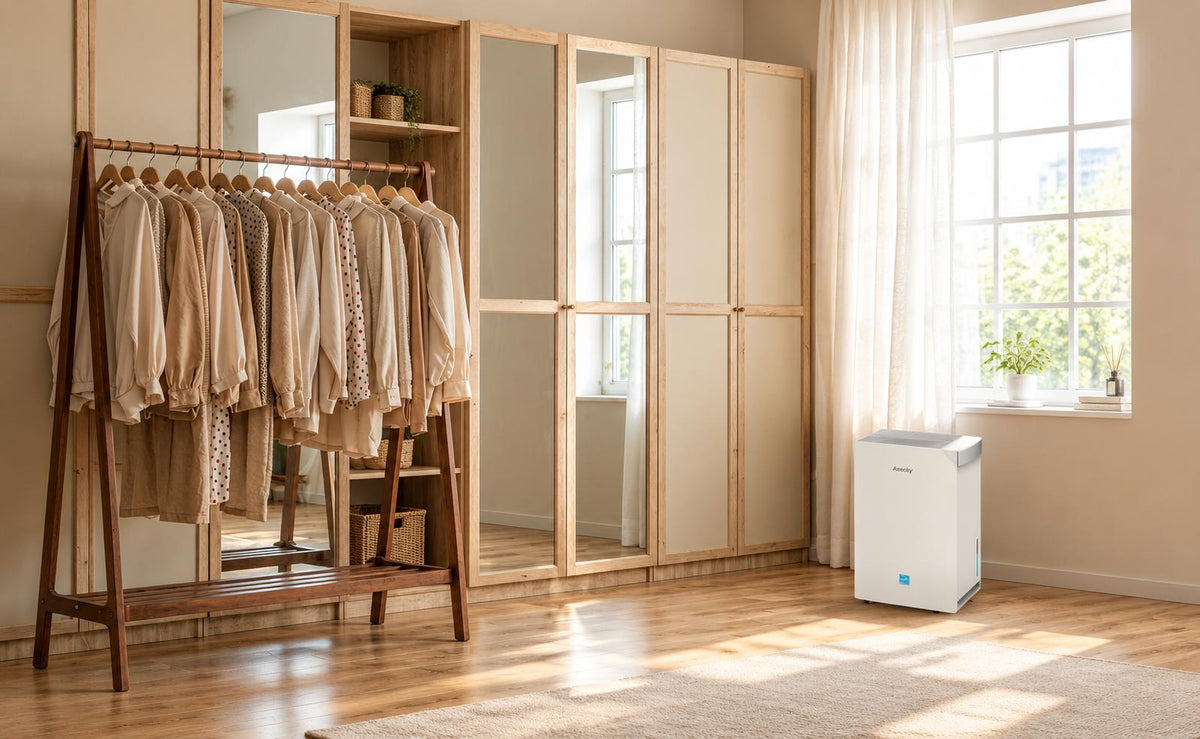
The most important features to look for in a dehumidifier are the right capacity, good energy efficiency, adjustable humidity control, convenient drainage, automatic shutoff, and easy maintenance. Noise level and smart controls can also matter, depending on where you plan to use the unit. The key is not to choose a model simply because it has the longest feature list. Instead, match its specifications to your room, moisture level, and daily routine. If you are wondering how to choose a dehumidifier, start with capacity and energy efficiency, then consider the features that make the unit easier to operate and maintain.
Start With the Most Important Dehumidifier Features
Not every feature deserves equal attention. A dehumidifier with Wi-Fi control is convenient, but it will not compensate for an undersized unit. Likewise, a large water tank is useful, but energy efficiency can have a bigger effect if the appliance runs for many hours every day.
The most important areas to compare are:
-
Moisture-removal capacity
-
Energy efficiency
-
Humidity control
-
Drainage
-
Automatic shutoff
-
Noise
-
Filter maintenance
-
Smart controls
-
Choose the Right Dehumidifier Capacity for Your Space
Capacity should be one of the first things you check.
Dehumidifier capacity is usually expressed in pints of water removed per 24 hours. However, choosing the correct size is not simply a matter of matching square footage to a number. ENERGY STAR states that the required capacity depends on both the size of the space and the moisture conditions in that space.
Dehumidifier Capacity for Room Size
A larger room generally requires more capacity, but a smaller room with severe moisture problems may also need a relatively powerful unit.
For example, a large basement with condensation, wet floors, or consistently high humidity has a greater moisture load than a similarly sized dry living room.
This is why dehumidifier capacity for room size should always be considered together with actual humidity conditions.
For larger spaces, you can compare models such as the Rhea 4500 sq. ft. dehumidifier and the Leo 001 Max 80-pint dehumidifier by looking at their stated capacity and intended coverage.
It is also worth remembering that current capacity ratings are based on standardized test conditions. ENERGY STAR notes that changes to the DOE test procedure resulted in lower-looking capacity ratings on some newer models compared with older ratings, so comparing newer and older models by pint number alone can be misleading.
-
Check the Energy Efficiency Rating
If your dehumidifier will operate for many hours each day, energy efficiency deserves close attention.
The most useful question is not simply, “How many watts does it use?” Instead, look at how much moisture it removes for the electricity consumed.
What Is Integrated Energy Factor?
Integrated Energy Factor (IEF) measures dehumidifier efficiency in liters of water removed per kilowatt-hour of electricity consumed. A higher IEF generally indicates better efficiency. The current ENERGY STAR criteria use IEF as the energy-efficiency metric for certified dehumidifiers.
This makes IEF more useful for comparing efficiency than looking at wattage alone.
ENERGY STAR Dehumidifier Features
An ENERGY STAR certification is another useful specification to check. Current ENERGY STAR requirements set minimum efficiency criteria based on product capacity for portable dehumidifiers.
For shoppers comparing energy-focused models, the AEOKY ENERGY STAR series provides a selection of models to review alongside their published specifications.
The Leo 4500 sq. ft. ENERGY STAR model is another example to consider when comparing capacity and energy-related specifications.
-
Look for Adjustable Humidity Control
A dehumidifier should not simply run continuously without considering the actual humidity level.
Look for adjustable dehumidifier humidity control settings that allow you to select a target relative humidity. A built-in humidistat can then monitor the room and cycle the unit as needed.
This feature matters because running a dehumidifier longer than necessary wastes electricity and can make a room uncomfortably dry.
A practical setting for many homes is around 40% to 50% relative humidity, although the appropriate level depends on the room and household needs.
Automatic humidity control is especially useful if the dehumidifier will operate while you are away. Instead of manually turning the machine on and off, the unit can respond to changing humidity levels.
-
Consider Continuous Drainage
A water tank works well if you only need occasional dehumidification. But if the unit runs every day, emptying the tank can quickly become a chore.
A dehumidifier with continuous drainage can send collected water through a hose to a suitable drain, allowing the appliance to operate without frequent tank emptying.
This is particularly useful for:
-
Basements
-
Laundry rooms
-
Long-term humidity control
-
High-moisture environments
-
Spaces where the unit runs unattended
Most portable dehumidifiers also have a water bucket and automatic shutoff. ENERGY STAR notes that automatic shutoff is typically used when the bucket becomes full, helping prevent overflow.
When comparing models, check whether continuous drainage is supported and whether the installation requires a particular hose or drain position.
-
Check Noise Levels and Operating Modes
Noise becomes more important when the dehumidifier is used in a bedroom, office, or other quiet space.
Look for multiple fan speeds or a sleep mode if nighttime operation matters. A lower fan speed may reduce noise, although it can also change how quickly moisture is removed.
Do not judge noise only by a product's headline specification. If available, compare the stated decibel level and look for independent testing or user feedback.
-
Look at Filter and Maintenance Features
A dehumidifier moves a lot of air, so its filter needs regular attention.
A washable or reusable filter can make routine maintenance easier and reduce the need for frequent replacement filters. Some models also include a filter-cleaning indicator.
Useful maintenance features include:
-
Washable air filter
-
Filter-cleaning reminder
-
Easy-access filter
-
Removable water tank
-
Easy-to-clean tank
-
Automatic defrost for applicable operating conditions
The easier a unit is to maintain, the more likely it is that the owner will keep it operating properly over time.
-
Consider Smart and Convenience Features
Smart controls are useful, but they should come after the basic performance specifications.
Depending on the model, useful convenience features may include:
-
Wi-Fi or app control
-
Remote monitoring
-
Timer settings
-
Automatic restart after a power interruption
-
Multiple fan speeds
-
Child lock
-
Display controls
These features can be helpful when the dehumidifier is located in a basement or another room that you do not visit frequently.
For example, a model such as the Arion Max 40-pint dehumidifier can be evaluated not only by its stated capacity but also by the operating and convenience features provided with the specific configuration.
How to Choose a Dehumidifier: A Simple Checklist
Before buying, ask these questions:
-
How large is the space? Use room size as a starting point for capacity.
-
How humid is the space? A damp basement may need more capacity than a similarly sized living room.
-
How often will it run? Frequent operation makes energy efficiency more important.
-
Do you want automatic humidity control? A built-in humidistat can reduce unnecessary operation.
-
Will you need continuous drainage? If the answer is yes, confirm that the model supports it.
-
Does noise matter? Consider sleep mode, fan speeds, and the stated noise level.
-
How much maintenance are you willing to do? A washable filter and accessible water tank can make regular care easier.
-
Is ENERGY STAR certification important to you? Check the current certification and efficiency information rather than relying only on marketing claims. ENERGY STAR publishes certified models and their performance information through its product database.
Final Thoughts
The best dehumidifier is not necessarily the model with the most features. It is the one whose capacity, efficiency, humidity control, drainage, and maintenance requirements match the space where it will be used. Start with dehumidifier capacity for room size, then check IEF and ENERGY STAR information if energy use is a priority. After that, consider practical features such as adjustable humidity control, continuous drainage, automatic shutoff, noise settings, and washable filters. Smart controls can add convenience, but they should not replace the fundamentals. A short checklist is often enough to narrow down the options and find a dehumidifier that fits both the room and your daily routine.


Leave a comment
This site is protected by hCaptcha and the hCaptcha Privacy Policy and Terms of Service apply.