

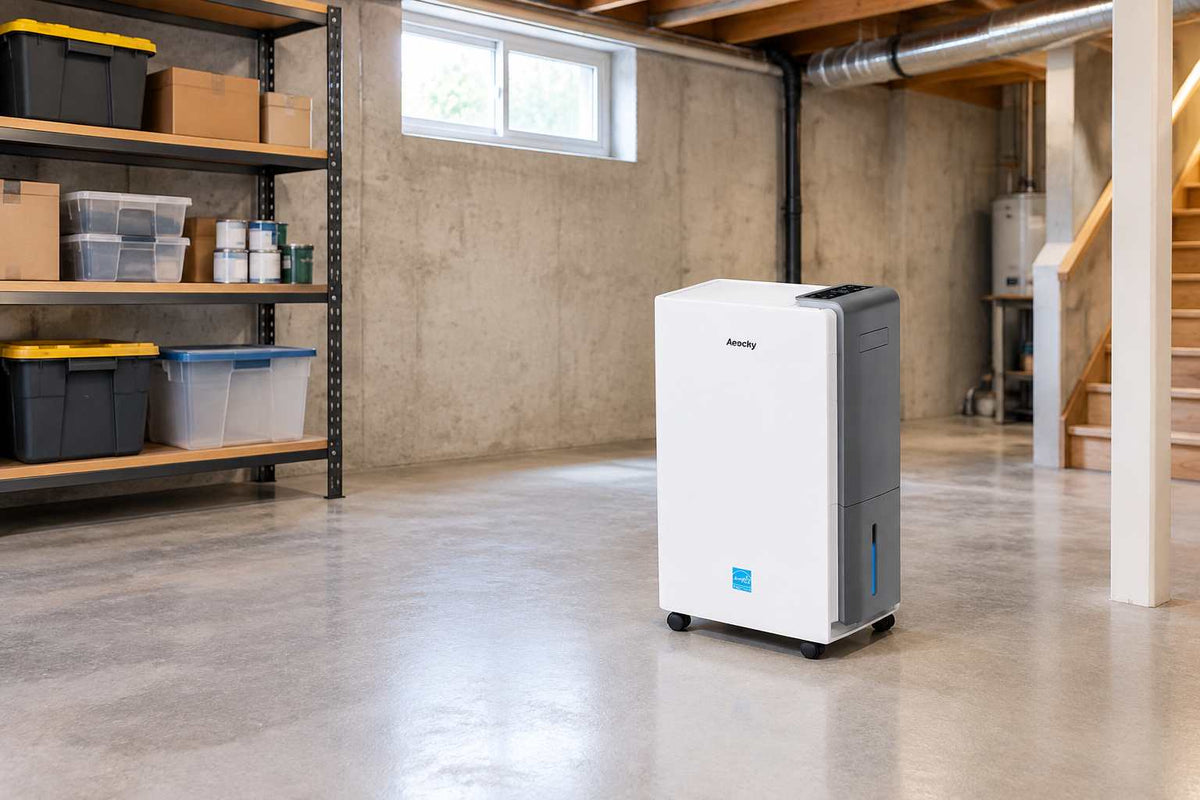
dehumidifier with pump

Aeocky Energy Star Dehumidifiers Compared: Which Model Fits Your Needs?

Aeocky Energy Star Dehumidifiers Compared: Which Model Fits Your Needs?
The right Aeocky Energy Star dehumidifier depends on the space you need to dry, how damp it gets, and how you plan to drain collected water. Rhea and Leo are useful starting points for comparison: Rhea is positioned for home and basement use, while the Leo Series includes models with a built-in pump for easier drainage. Neither a series name nor a maximum coverage figure tells the whole story. Before choosing, compare the exact model’s moisture-removal capacity, room conditions, drainage options, operating requirements, and verified ENERGY STAR status.

How to Choose Between Aeocky Dehumidifiers

Start With Room Size and Moisture Levels

Measure the room and assess how often it feels damp. A bedroom with occasional condensation has different needs from a basement with persistent musty odors or visible moisture. Consider ceiling height, connected rooms, temperature, ventilation, and whether doors will usually stay open. These factors affect how evenly dry air circulates and how hard a unit may need to work.
If you are deciding how to choose the right Aeocky dehumidifier, treat the stated coverage area as a guide rather than a guarantee. A space with heavy moisture problems may need more capacity than a similarly sized room that is only mildly damp. If you are comparing whole-house dehumidifiers, confirm whether you need a portable unit or a system designed to connect to ductwork. A large coverage claim alone does not mean a portable model is a ducted whole-house system.

Compare Energy Efficiency and Drainage

ENERGY STAR certified dehumidifiers meet energy-performance criteria for their product category. Certification is useful, but it should be considered alongside moisture-removal capacity, noise, controls, and maintenance. ENERGY STAR uses Integrated Energy Factor (IEF) to measure moisture removed per unit of energy; a higher IEF generally indicates better efficiency under the applicable test conditions.
Drainage also affects day-to-day convenience. A tank must be emptied when full. A gravity drain needs a suitable outlet below the unit, while a dehumidifier with pump can move water to a higher or more distant drain within the manufacturer's stated limits. Check the hose route and drainage instructions before buying.

Aeocky Dehumidifier Models Compared

Rhea Series for Home and Basement Use

The Aeocky Rhea Series dehumidifier is worth comparing for home and basement applications. Different versions may have different moisture-removal capacities, coverage claims, and operating features, so use the exact model listing rather than assuming every Rhea unit has identical specifications.
Rhea may suit shoppers looking for a higher-capacity option who can arrange a suitable drainage point. Before choosing a model, confirm its rated capacity, recommended coverage, tank details, hose compatibility, noise information, and warranty. If the room is persistently damp, also look for the source of moisture; a dehumidifier should not replace repairs for leaks or water intrusion.

Leo Series for Convenient Pump Drainage

The Aeocky Leo Series dehumidifier with pump is a relevant option when carrying and emptying a water tank would be inconvenient or when the available drain is higher than the unit. A built-in pump can make continuous drainage easier, provided the installation stays within the model's stated pumping distance and lift limits.
This feature can be especially useful in a basement that needs regular moisture control. Still, a pump does not automatically make a unit the best choice for every room. Compare capacity, energy performance, noise, dimensions, and maintenance needs, and confirm what drainage accessories are included or sold separately.

What to Consider When Comparing Other Models

When reviewing Aeocky dehumidifier models compared side by side, focus on differences that affect your own space rather than choosing by series name alone. Check the rated moisture removal, recommended room coverage, drainage method, tank capacity, filter maintenance, and operating conditions. Smaller or less damp rooms may not need the same capacity as a large basement, while a unit that is too small may run for long periods without keeping humidity at the desired level.
Also verify certification for the exact model. ENERGY STAR certification and ENERGY STAR Most Efficient recognition are not interchangeable claims, and eligibility can vary by model and program year. Look up the specific product in current official records before relying on a certification statement.

Which Dehumidifier Is Right for Different Room Sizes?

For a small, enclosed room with mild dampness, start by comparing units whose rated capacity suits the actual moisture load. For a large basement or connected area, look at higher-capacity models and consider whether air can circulate freely between sections of the space. If drainage is difficult, a pump may be more useful than a small difference in coverage.
A practical shortlist can follow four steps:
  • Measure the area and identify the dampest parts of the space.
  • Check for leaks, condensation, or other moisture sources before choosing a unit.
  • Compare rated capacity and efficiency using the same measurement standards.
  • Choose a drainage method that fits the room and your maintenance routine.
If you are asking, “Which Aeocky dehumidifier is best for my home?” begin with the space that needs the most help. Then compare the models that meet its capacity and drainage requirements. This approach is more useful than selecting a unit based only on the largest advertised coverage area.

What to Check Before Buying

Before ordering, verify the exact model number, moisture-removal rating, coverage guidance, noise level, tank size, drainage options, warranty, and current price. If energy use matters, compare published efficiency data for products tested under the same standard. Check the ENERGY STAR database for the exact model rather than assuming every unit in a product family is certified.
Remember that electricity use depends on more than the label. Runtime changes with moisture entering the space, the target humidity, temperature, and how often doors or windows are opened. A hygrometer can help you monitor indoor relative humidity and see whether the unit is keeping conditions within your preferred range.
For additional background, read our guide to what a dehumidifier does. If you are sizing a unit for an open basement or connected living area, our article on choosing a dehumidifier for large rooms offers related guidance.

Final Thoughts

Choosing between Aeocky Energy Star dehumidifiers comes down to matching capacity, drainage, and verified efficiency information to the space you need to dry. Rhea is worth comparing for home and basement use, while Leo may be a better fit when a built-in pump solves a practical drainage problem. Check the specifications for the exact model, confirm its current certification status, and consider the room’s moisture conditions before buying. The most suitable unit is not necessarily the one with the biggest coverage claim; it is the one that can manage the space reliably and fit your drainage and maintenance needs.
 

Reading next

Best Dehumidifier for Apartments: How to Choose the Right Model for Your Space
What to Check Before Buying an Aeocky Dehumidifier

Leave a comment

This site is protected by hCaptcha and the hCaptcha Privacy Policy and Terms of Service apply.

Aeocky Energy Star Dehumidifiers Compared: Which Model Fits Your Needs?

The right Aeocky Energy Star dehumidifier depends on the space you need to dry, how damp it gets, and how you plan to drain collected water. Rhea and Leo are useful starting points for comparison: Rhea is positioned for home and basement use, while the Leo Series includes models with a built-in pump for easier drainage. Neither a series name nor a maximum coverage figure tells the whole story. Before choosing, compare the exact model’s moisture-removal capacity, room conditions, drainage options, operating requirements, and verified ENERGY STAR status.

How to Choose Between Aeocky Dehumidifiers

Start With Room Size and Moisture Levels

Measure the room and assess how often it feels damp. A bedroom with occasional condensation has different needs from a basement with persistent musty odors or visible moisture. Consider ceiling height, connected rooms, temperature, ventilation, and whether doors will usually stay open. These factors affect how evenly dry air circulates and how hard a unit may need to work.
If you are deciding how to choose the right Aeocky dehumidifier, treat the stated coverage area as a guide rather than a guarantee. A space with heavy moisture problems may need more capacity than a similarly sized room that is only mildly damp. If you are comparing whole-house dehumidifiers, confirm whether you need a portable unit or a system designed to connect to ductwork. A large coverage claim alone does not mean a portable model is a ducted whole-house system.

Compare Energy Efficiency and Drainage

ENERGY STAR certified dehumidifiers meet energy-performance criteria for their product category. Certification is useful, but it should be considered alongside moisture-removal capacity, noise, controls, and maintenance. ENERGY STAR uses Integrated Energy Factor (IEF) to measure moisture removed per unit of energy; a higher IEF generally indicates better efficiency under the applicable test conditions.
Drainage also affects day-to-day convenience. A tank must be emptied when full. A gravity drain needs a suitable outlet below the unit, while a dehumidifier with pump can move water to a higher or more distant drain within the manufacturer's stated limits. Check the hose route and drainage instructions before buying.

Aeocky Dehumidifier Models Compared

Rhea Series for Home and Basement Use

The Aeocky Rhea Series dehumidifier is worth comparing for home and basement applications. Different versions may have different moisture-removal capacities, coverage claims, and operating features, so use the exact model listing rather than assuming every Rhea unit has identical specifications.
Rhea may suit shoppers looking for a higher-capacity option who can arrange a suitable drainage point. Before choosing a model, confirm its rated capacity, recommended coverage, tank details, hose compatibility, noise information, and warranty. If the room is persistently damp, also look for the source of moisture; a dehumidifier should not replace repairs for leaks or water intrusion.

Leo Series for Convenient Pump Drainage

The Aeocky Leo Series dehumidifier with pump is a relevant option when carrying and emptying a water tank would be inconvenient or when the available drain is higher than the unit. A built-in pump can make continuous drainage easier, provided the installation stays within the model's stated pumping distance and lift limits.
This feature can be especially useful in a basement that needs regular moisture control. Still, a pump does not automatically make a unit the best choice for every room. Compare capacity, energy performance, noise, dimensions, and maintenance needs, and confirm what drainage accessories are included or sold separately.

What to Consider When Comparing Other Models

When reviewing Aeocky dehumidifier models compared side by side, focus on differences that affect your own space rather than choosing by series name alone. Check the rated moisture removal, recommended room coverage, drainage method, tank capacity, filter maintenance, and operating conditions. Smaller or less damp rooms may not need the same capacity as a large basement, while a unit that is too small may run for long periods without keeping humidity at the desired level.
Also verify certification for the exact model. ENERGY STAR certification and ENERGY STAR Most Efficient recognition are not interchangeable claims, and eligibility can vary by model and program year. Look up the specific product in current official records before relying on a certification statement.

Which Dehumidifier Is Right for Different Room Sizes?

For a small, enclosed room with mild dampness, start by comparing units whose rated capacity suits the actual moisture load. For a large basement or connected area, look at higher-capacity models and consider whether air can circulate freely between sections of the space. If drainage is difficult, a pump may be more useful than a small difference in coverage.
A practical shortlist can follow four steps:
  • Measure the area and identify the dampest parts of the space.
  • Check for leaks, condensation, or other moisture sources before choosing a unit.
  • Compare rated capacity and efficiency using the same measurement standards.
  • Choose a drainage method that fits the room and your maintenance routine.
If you are asking, “Which Aeocky dehumidifier is best for my home?” begin with the space that needs the most help. Then compare the models that meet its capacity and drainage requirements. This approach is more useful than selecting a unit based only on the largest advertised coverage area.

What to Check Before Buying

Before ordering, verify the exact model number, moisture-removal rating, coverage guidance, noise level, tank size, drainage options, warranty, and current price. If energy use matters, compare published efficiency data for products tested under the same standard. Check the ENERGY STAR database for the exact model rather than assuming every unit in a product family is certified.
Remember that electricity use depends on more than the label. Runtime changes with moisture entering the space, the target humidity, temperature, and how often doors or windows are opened. A hygrometer can help you monitor indoor relative humidity and see whether the unit is keeping conditions within your preferred range.
For additional background, read our guide to what a dehumidifier does. If you are sizing a unit for an open basement or connected living area, our article on choosing a dehumidifier for large rooms offers related guidance.

Final Thoughts

Choosing between Aeocky Energy Star dehumidifiers comes down to matching capacity, drainage, and verified efficiency information to the space you need to dry. Rhea is worth comparing for home and basement use, while Leo may be a better fit when a built-in pump solves a practical drainage problem. Check the specifications for the exact model, confirm its current certification status, and consider the room’s moisture conditions before buying. The most suitable unit is not necessarily the one with the biggest coverage claim; it is the one that can manage the space reliably and fit your drainage and maintenance needs.


Popular Posts
Best Dehumidifier for a Home With Limited Drainage Options
What to Check Before Buying an Aeocky Dehumidifier
Aeocky Energy Star Dehumidifiers Compared: Which Model Fits Your Needs?
Best Dehumidifier for Apartments: How to Choose the Right Model for Your Space
Dehumidifier Noise Levels Explained: How to Choose a Quieter Model
Portable vs. Whole-House Dehumidifier: Which Is Right for Your Home?
Best Dehumidifier for Kitchens: How to Manage Cooking Moisture and Humidity
Dehumidifier Replacement Filters: How to Choose the Right Filter for Your Model
Aeocky Leo Lite vs. Rhea Dehumidifier: Which Model Should You Buy?
Best Dehumidifier with Pump for Basement: What to Look For Before Buying
Aeocky Dehumidifier Buying Guide: How to Choose the Right Model for Your Home
Energy Star Dehumidifier for Home: How to Choose an Efficient Model
Best Dehumidifiers for Home in 2026: How to Choose the Right Model
Best Dehumidifier for Laundry Rooms: How to Prevent Moisture, Odors & Dry Clothes Faster
Best Dehumidifier for RVs: How to Choose the Right Size, Power & Features for Travel Use
Best Dehumidifier for Garages: How to Protect Tools, Cars & Storage Items from Moisture
Best Dehumidifier for Grow Rooms: How to Control Humidity for Indoor Plants
How to Choose the Best Dehumidifier for Large Rooms
How to Choose the Best Dehumidifier for Your Bathroom
What Is the Most Efficient Type of Dehumidifier?
Subscribe Us
Subscribe to our newsletter and receive a selection of cool articles every weeks