

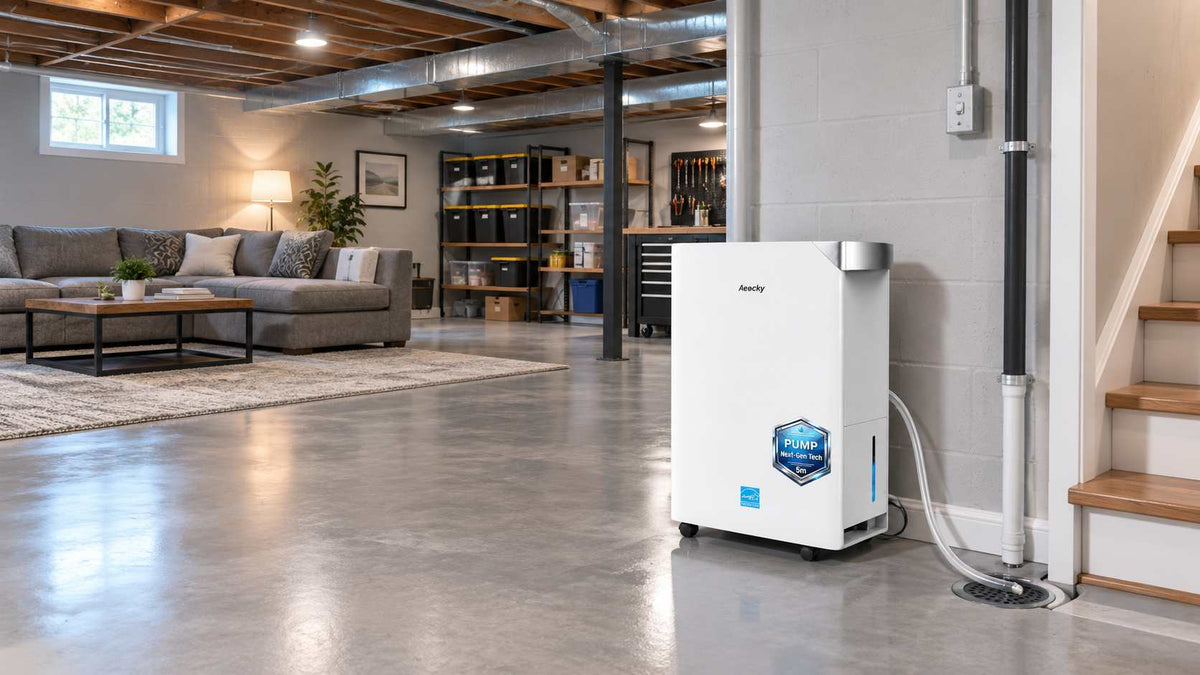
The best dehumidifier with pump for basement use depends on more than moisture-removal capacity. The first question is where the collected water needs to go. If your basement has a floor drain below the unit, gravity drainage may be enough. If the drain, sink, or discharge point is higher than the dehumidifier, a pump can move water upward without requiring you to empty the tank manually. From there, compare capacity, humidity control, energy efficiency, noise, and hose setup. This guide explains how to choose a dehumidifier with pump for basement use and what to check before buying.
Do You Need a Dehumidifier With a Pump in Your Basement?
A basement dehumidifier with pump is most useful when continuous drainage is needed but gravity cannot move water to the desired drain.
If you have a suitable dehumidifier for basement floor drain placement, a drain hose can often run downward from the unit into the floor drain. In that situation, a pump may not be necessary.
But if the nearest sink or drain is above the dehumidifier, you need a dehumidifier that pumps water uphill. A built-in pump can move condensate upward through a hose instead of relying on gravity.
When Gravity Drainage Is Enough
A dehumidifier with continuous drainage for basement use can work without a pump when the drain outlet is lower than the unit's drainage port and the hose can maintain a downward path.
For example, a basement dehumidifier with drain hose can continuously discharge water into a nearby floor drain. Keep the hose as straight and downward-sloping as possible.
When You Need a Built-In Pump
A dehumidifier with built-in pump makes more sense when water must travel upward to reach a sink, standpipe, or other drainage point.
This is also why a dehumidifier with automatic pump can be useful for long-running basement operation. Once configured correctly, the unit can remove moisture and discharge condensate without requiring frequent bucket emptying.
How Does a Dehumidifier Pump Work?
If you are wondering how does a dehumidifier pump work, the basic process is straightforward. The dehumidifier collects moisture from the air as condensate. Instead of allowing that water to flow only downward, the built-in pump pushes it through the discharge hose toward a higher drainage point.
The important specification is not simply that a model has a pump. Check the manufacturer's stated pump capability and make sure it suits the height and distance of your drainage route.
This is especially important for a dehumidifier pump for basement use because basement layouts vary. A short route to a utility sink is very different from a long vertical run to an upper-level discharge point.
What to Look for in a Basement Dehumidifier With Pump
1. Capacity and Basement Size
The best basement dehumidifier with pump should have enough capacity for the space and its moisture load.
Do not select a model based only on square footage. A cool, mildly humid basement and a consistently damp basement can require different levels of moisture removal.
A high capacity dehumidifier with pump may make sense for a large basement or a space that stays humid for long periods.
Aeocky's Leo series is specifically designed around this type of application. The Aeocky Leo Series dehumidifier with built-in pump is available in models with up to 80, 105, or 140 pints per day and coverage up to 4,500, 5,500, or 8,000 square feet, depending on the model.
2. Pump and Drainage Setup
When comparing a basement dehumidifier with drain pump, look at the entire drainage system rather than the pump alone.
Check:
- Where the water needs to go
- How high the water must travel
- The required hose length
- Whether the hose connection matches
- Whether the unit also supports gravity drainage
A dehumidifier with pump and drain hose gives you more flexibility when the basement does not have a convenient floor drain.
3. Humidity Control
A basement dehumidifier may run for many hours, especially during humid seasons. Automatic humidity control can reduce the need to adjust the unit manually.
Look for a built-in humidistat or automatic humidity setting that lets the dehumidifier with drain pump maintain a selected humidity level.
4. Energy Efficiency
If your basement needs regular dehumidification, efficiency matters over the long term.
An energy efficient dehumidifier with pump can be useful when the unit operates frequently. ENERGY STAR certification is another specification worth checking when comparing models.
Aeocky's Leo series is listed as ENERGY STAR Most Efficient 2025 and combines a built-in drain pump with automatic humidity control. This makes it particularly relevant when drainage and energy efficiency are both priorities.
5. Noise Level
Basements are often used as living areas, offices, laundry rooms, or storage spaces. If people spend time there, noise becomes part of the buying decision.
A quiet dehumidifier with pump can be more suitable for a finished basement than a model that prioritizes capacity alone.
Aeocky lists the Leo series as having whisper-quiet operation, while specific noise performance can vary by model and operating mode.
6. Cold-Temperature Performance
Basements can be significantly cooler than the rest of the home. Before buying, check the operating temperature range and whether the model has features designed for lower-temperature conditions.
This matters because the ideal dehumidifier with pump for basement is not simply the model with the highest advertised capacity. It should also suit the environment where it will operate.
Best Dehumidifier With Pump for Basement: How to Choose the Right Size
The right size depends on both room dimensions and moisture conditions.
For a smaller or moderately damp basement, avoid automatically choosing the largest available unit. Match the capacity to the space and expected humidity level.
For a large or consistently damp basement, a high capacity dehumidifier with pump may be more appropriate. Aeocky's Leo range provides multiple capacity levels, allowing users to select a model according to coverage requirements rather than using one capacity for every basement.
If your basement extends into a large open area or connects to other rooms, you can also compare whole-space models such as the Aeocky Rhea Series. Rhea provides continuous gravity drainage rather than a built-in pump, so it is better suited when the drainage layout already supports gravity flow.
How to Set Up a Basement Dehumidifier With Pump
Knowing how to set up a basement dehumidifier with pump helps prevent drainage problems.
1. Position the unit.
Place the dehumidifier on a stable, level surface with sufficient clearance around the air intake and outlet.
2. Identify the drainage destination.
Determine exactly where the water will discharge before connecting the hose.
3. Connect the drain hose.
Attach the hose securely to the appropriate pump outlet and route it toward the destination without unnecessary bends.
4. Check the vertical lift.
Make sure the required height is within the pump's specified capability.
5. Test the system.
Run the dehumidifier and confirm that water reaches the intended drain without leaks, kinks, or backflow.
How to Drain a Basement Dehumidifier Without a Pump
If you are asking how to drain a basement dehumidifier, a floor drain is usually the simplest option when available.
A gravity hose can provide basement dehumidifier continuous drainage as long as the drainage point is lower than the unit's outlet. If the hose needs to rise before reaching the drain, gravity drainage may stop working properly.
That is the key distinction between a standard continuous-drain setup and a pump-equipped system.
Why Use a Dehumidifier Pump in a Basement?
So, why use a dehumidifier pump in a basement?
The main reason is drainage flexibility. A pump allows condensate to move upward, which can make continuous operation possible even when the basement lacks a conveniently positioned floor drain.
If you are still asking do I need a dehumidifier with a pump, look at your drainage path first. If water can flow downward naturally, a pump may add little value. If water must travel upward, a pump can be a practical feature.
That is also the simplest answer to how to choose a basement dehumidifier with pump: start with drainage, then match capacity, humidity control, efficiency, noise, and temperature requirements to your basement.
Final Thoughts
The best dehumidifier with pump for basement use is not automatically the largest or most powerful model. The right choice depends on how damp the basement is, how much space needs coverage, and where the collected water needs to go. A pump is particularly useful when the drainage destination is higher than the unit, while a simple hose may be enough when a floor drain is nearby. After solving the drainage question, compare capacity, humidity control, efficiency, noise, and operating temperature. A little planning before purchase can make the difference between a dehumidifier that works well and one that is difficult to drain or maintain.


Leave a comment
This site is protected by hCaptcha and the hCaptcha Privacy Policy and Terms of Service apply.