

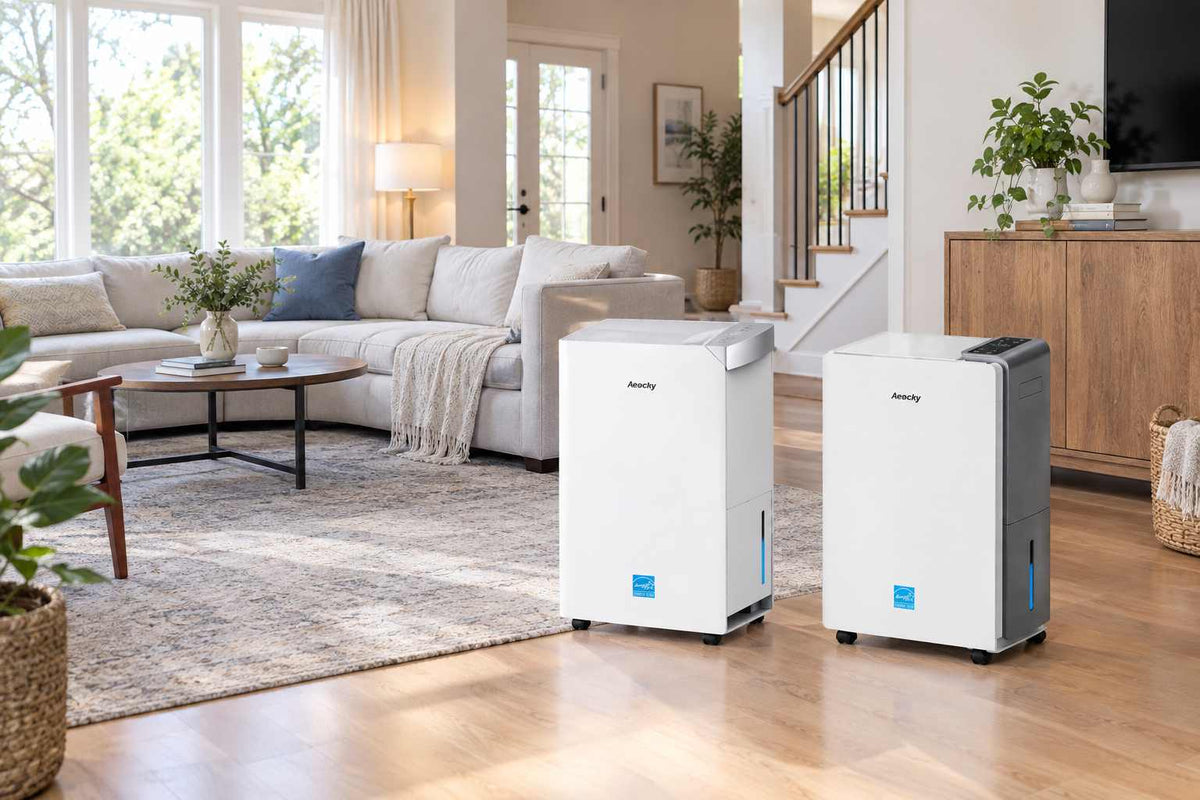
Dehumidifier

Aeocky Leo Lite vs. Rhea Dehumidifier: Which Model Should You Buy?

Aeocky Leo Lite vs. Rhea Dehumidifier: Which Model Should You Buy?

Choosing between the Aeocky Leo-Lite and Rhea dehumidifier series depends on the capacity you need, the size of your space, and the features you value. Both offer smart automatic humidity control and continuous gravity drainage, but their listed capacity options and coverage figures differ. Leo-Lite models are listed at up to 74, 105, and 140 pints per day, while Rhea models offer up to 80, 105, and 140 pints per day. Their energy certification labels also differ. Before deciding which Aeocky dehumidifier to buy, compare the exact model specifications rather than treating either series as a single machine.

1. Aeocky Leo Lite vs. Rhea: Key Differences at a Glance

Aeocky's official product pages describe three models in each series. The following table summarizes the published series-level information.

Feature Aeocky Leo-Lite Aeocky Rhea
Listed capacity options 74, 105, and 140 pints/day 80, 105, and 140 pints/day
Listed coverage options Up to 5,000, 5,500, and 7,500 sq. ft. Up to 5,500, 6,000, and 8,000 sq. ft.
Energy label on product page ENERGY STAR Certified 2025 ENERGY STAR Most Efficient 2025
Humidity control Smart Auto-Humidity Smart Auto-Humidity
Drainage Continuous gravity drain with hose Continuous gravity drain with hose
Noise description Whisper-Quiet Performance Whisper-Quiet Operation

These figures are published by Aeocky on its Leo-Lite series page and Rhea series page. They describe different models within each series, not one specification shared by every unit.

Dehumidification Capacity and Room Coverage

Capacity refers to the amount of moisture a dehumidifier can remove under specified testing conditions. Advertised coverage gives buyers a reference for the space a model is intended to serve, but it does not guarantee the same results in every home.

Aeocky lists the Leo-Lite series with coverage options up to 5,000, 5,500, and 7,500 square feet. Rhea's listed options extend to 5,500, 6,000, and 8,000 square feet.

That difference may matter when comparing the largest models, but it does not automatically make Rhea the right choice for every household. A smaller area with a substantial moisture problem may need more capacity than a larger, relatively dry space. Temperature, humidity, ventilation, and moisture sources all affect performance.

Energy Certification and Humidity Controls

The two series have different energy labels on their official pages. Leo-Lite is listed as ENERGY STAR Certified 2025, while Rhea is listed as ENERGY STAR Most Efficient 2025.

These labels should be reported as published, without turning them into an unsupported claim about the exact electricity cost of every model. For a more precise energy efficiency dehumidifier comparison, check the certification and efficiency data for the specific model you intend to purchase.

Both series list Smart Auto-Humidity as a feature. This is useful when you want the appliance to manage humidity automatically instead of requiring constant manual adjustments. However, the presence of the same feature does not establish that the two series use identical control settings or operate in exactly the same way.

Drainage and Noise Information

Both product pages list continuous gravity drainage with a drain hose. This can be useful when the unit is placed near a suitable drain, reducing the need to empty collected water manually. Gravity drainage requires an appropriate drainage route; do not assume that either series includes a built-in drain pump.

Aeocky describes Leo-Lite as offering “Whisper-Quiet Performance” and Rhea as offering “Whisper-Quiet Operation.” These are the manufacturer's descriptions. The pages do not establish, through those phrases alone, that one series is quieter than the other. If you plan to use a dehumidifier for bedroom use, check the noise specifications for the exact model before buying.

2. What Is the Difference Between Aeocky Leo Lite and Rhea?

The clearest differences shown on the official product pages are the available capacity and coverage options, along with the energy certification labels. Both series also list automatic humidity control and continuous gravity drainage.

Understanding the Leo-Lite Series

Leo-Lite offers three listed capacity options, starting at 74 pints per day and extending to 140 pints per day. Its advertised coverage ranges from up to 5,000 to 7,500 square feet, depending on the selected model.

This range gives buyers several sizes to compare. The important step is to select the model whose published specifications match the room and moisture conditions, rather than assuming the entry-level model represents the entire series.

See the official Aeocky Leo-Lite range for current model options.

Understanding the Rhea Series

Rhea offers listed capacities of 80, 105, and 140 pints per day, with advertised coverage options up to 5,500, 6,000, and 8,000 square feet. Its product page also carries the ENERGY STAR Most Efficient 2025 label.

The larger advertised coverage options may make the higher-capacity Rhea models worth comparing for bigger spaces. Still, room size alone is not enough to determine which model will work best. Consider how damp the area is and whether the published capacity suits the actual conditions.

See the official Aeocky Rhea range for the model-specific details.

3. Which Aeocky Dehumidifier Should I Buy?

There is no single answer for every home. Start with your room, moisture level, and preferred features.

Choosing a Model for Everyday Home Use

For a bedroom or another regularly occupied room, consider the exact model's noise rating, dimensions, capacity, and drainage requirements. Neither series should be described as the better bedroom choice without comparable model-level evidence.

If you are unfamiliar with how these appliances work, Aeocky's article on what a dehumidifier does explains their role in managing indoor moisture.

Choosing a Model for a Larger Area

If you need to manage humidity across a large basement or living area, compare the models with the coverage and capacity you require. Rhea has the higher advertised maximum coverage in the two series, while both ranges offer multiple capacity options.

For more help matching capacity to space, read how to choose a dehumidifier for large rooms.

Comparing Energy Efficiency

Rhea carries the ENERGY STAR Most Efficient 2025 label on its product page, while Leo-Lite is labeled ENERGY STAR Certified 2025. This is a relevant distinction, but it is not enough by itself to calculate an individual household's running costs.

Compare the efficiency information for the exact models and consider how often each unit is likely to run. Electricity costs depend on power consumption, runtime, operating conditions, and your local electricity rate.

4. What to Check Before Buying a Dehumidifier

First, match capacity to the room and the amount of moisture you need to remove. Advertised coverage is a useful starting point, not a guarantee of performance under all conditions.

Next, consider drainage. Both series list continuous gravity drainage, so check whether you have a suitable drain location and hose route. If you need pumped drainage, verify the product specifications rather than assuming a pump is included.

Finally, check the exact model's current price, certification, dimensions, noise information, and warranty terms. Product pages can change, and series-level details may not apply to every variant.

You can also consult Aeocky's guide to the ideal indoor humidity level when deciding what humidity level you want to maintain.

5. Frequently Asked Questions

Is Leo-Lite suitable for a bedroom?

It may be suitable depending on the model's capacity, dimensions, and noise specifications. Check the exact unit's published details before choosing it for a sleeping area.

Is Rhea better for a large basement?

Rhea offers models with advertised coverage up to 8,000 square feet, compared with up to 7,500 square feet for Leo-Lite. Whether that difference matters depends on the basement's size and moisture load.

Which series is more energy-efficient?

The official pages list different energy labels: ENERGY STAR Certified 2025 for Leo-Lite and ENERGY STAR Most Efficient 2025 for Rhea. Compare the exact models' efficiency data before drawing conclusions about electricity use or cost.

Final Thoughts

The Aeocky Leo-Lite and Rhea series both offer multiple capacity options, automatic humidity control, and continuous gravity drainage. Rhea has the higher advertised maximum coverage, while the two series carry different energy certification labels. Those are useful starting points, but they do not settle every buying decision. Check the specifications for the exact model, consider the room's moisture conditions, and confirm drainage and noise requirements before purchasing. The best dehumidifier is the one that matches your home's needs, not simply the one with the largest coverage figure.

Reading next

Best Dehumidifier with Pump for Basement: What to Look For Before Buying
Dehumidifier Replacement Filters: How to Choose the Right Filter for Your Model

Leave a comment

This site is protected by hCaptcha and the hCaptcha Privacy Policy and Terms of Service apply.

Aeocky Leo Lite vs. Rhea Dehumidifier: Which Model Should You Buy?

Choosing between the Aeocky Leo-Lite and Rhea dehumidifier series depends on the capacity you need, the size of your space, and the features you value. Both offer smart automatic humidity control and continuous gravity drainage, but their listed capacity options and coverage figures differ. Leo-Lite models are listed at up to 74, 105, and 140 pints per day, while Rhea models offer up to 80, 105, and 140 pints per day. Their energy certification labels also differ. Before deciding which Aeocky dehumidifier to buy, compare the exact model specifications rather than treating either series as a single machine.

1. Aeocky Leo Lite vs. Rhea: Key Differences at a Glance

Aeocky's official product pages describe three models in each series. The following table summarizes the published series-level information.

Feature Aeocky Leo-Lite Aeocky Rhea
Listed capacity options 74, 105, and 140 pints/day 80, 105, and 140 pints/day
Listed coverage options Up to 5,000, 5,500, and 7,500 sq. ft. Up to 5,500, 6,000, and 8,000 sq. ft.
Energy label on product page ENERGY STAR Certified 2025 ENERGY STAR Most Efficient 2025
Humidity control Smart Auto-Humidity Smart Auto-Humidity
Drainage Continuous gravity drain with hose Continuous gravity drain with hose
Noise description Whisper-Quiet Performance Whisper-Quiet Operation

These figures are published by Aeocky on its Leo-Lite series page and Rhea series page. They describe different models within each series, not one specification shared by every unit.

Dehumidification Capacity and Room Coverage

Capacity refers to the amount of moisture a dehumidifier can remove under specified testing conditions. Advertised coverage gives buyers a reference for the space a model is intended to serve, but it does not guarantee the same results in every home.

Aeocky lists the Leo-Lite series with coverage options up to 5,000, 5,500, and 7,500 square feet. Rhea's listed options extend to 5,500, 6,000, and 8,000 square feet.

That difference may matter when comparing the largest models, but it does not automatically make Rhea the right choice for every household. A smaller area with a substantial moisture problem may need more capacity than a larger, relatively dry space. Temperature, humidity, ventilation, and moisture sources all affect performance.

Energy Certification and Humidity Controls

The two series have different energy labels on their official pages. Leo-Lite is listed as ENERGY STAR Certified 2025, while Rhea is listed as ENERGY STAR Most Efficient 2025.

These labels should be reported as published, without turning them into an unsupported claim about the exact electricity cost of every model. For a more precise energy efficiency dehumidifier comparison, check the certification and efficiency data for the specific model you intend to purchase.

Both series list Smart Auto-Humidity as a feature. This is useful when you want the appliance to manage humidity automatically instead of requiring constant manual adjustments. However, the presence of the same feature does not establish that the two series use identical control settings or operate in exactly the same way.

Drainage and Noise Information

Both product pages list continuous gravity drainage with a drain hose. This can be useful when the unit is placed near a suitable drain, reducing the need to empty collected water manually. Gravity drainage requires an appropriate drainage route; do not assume that either series includes a built-in drain pump.

Aeocky describes Leo-Lite as offering “Whisper-Quiet Performance” and Rhea as offering “Whisper-Quiet Operation.” These are the manufacturer's descriptions. The pages do not establish, through those phrases alone, that one series is quieter than the other. If you plan to use a dehumidifier for bedroom use, check the noise specifications for the exact model before buying.

2. What Is the Difference Between Aeocky Leo Lite and Rhea?

The clearest differences shown on the official product pages are the available capacity and coverage options, along with the energy certification labels. Both series also list automatic humidity control and continuous gravity drainage.

Understanding the Leo-Lite Series

Leo-Lite offers three listed capacity options, starting at 74 pints per day and extending to 140 pints per day. Its advertised coverage ranges from up to 5,000 to 7,500 square feet, depending on the selected model.

This range gives buyers several sizes to compare. The important step is to select the model whose published specifications match the room and moisture conditions, rather than assuming the entry-level model represents the entire series.

See the official Aeocky Leo-Lite range for current model options.

Understanding the Rhea Series

Rhea offers listed capacities of 80, 105, and 140 pints per day, with advertised coverage options up to 5,500, 6,000, and 8,000 square feet. Its product page also carries the ENERGY STAR Most Efficient 2025 label.

The larger advertised coverage options may make the higher-capacity Rhea models worth comparing for bigger spaces. Still, room size alone is not enough to determine which model will work best. Consider how damp the area is and whether the published capacity suits the actual conditions.

See the official Aeocky Rhea range for the model-specific details.

3. Which Aeocky Dehumidifier Should I Buy?

There is no single answer for every home. Start with your room, moisture level, and preferred features.

Choosing a Model for Everyday Home Use

For a bedroom or another regularly occupied room, consider the exact model's noise rating, dimensions, capacity, and drainage requirements. Neither series should be described as the better bedroom choice without comparable model-level evidence.

If you are unfamiliar with how these appliances work, Aeocky's article on what a dehumidifier does explains their role in managing indoor moisture.

Choosing a Model for a Larger Area

If you need to manage humidity across a large basement or living area, compare the models with the coverage and capacity you require. Rhea has the higher advertised maximum coverage in the two series, while both ranges offer multiple capacity options.

For more help matching capacity to space, read how to choose a dehumidifier for large rooms.

Comparing Energy Efficiency

Rhea carries the ENERGY STAR Most Efficient 2025 label on its product page, while Leo-Lite is labeled ENERGY STAR Certified 2025. This is a relevant distinction, but it is not enough by itself to calculate an individual household's running costs.

Compare the efficiency information for the exact models and consider how often each unit is likely to run. Electricity costs depend on power consumption, runtime, operating conditions, and your local electricity rate.

4. What to Check Before Buying a Dehumidifier

First, match capacity to the room and the amount of moisture you need to remove. Advertised coverage is a useful starting point, not a guarantee of performance under all conditions.

Next, consider drainage. Both series list continuous gravity drainage, so check whether you have a suitable drain location and hose route. If you need pumped drainage, verify the product specifications rather than assuming a pump is included.

Finally, check the exact model's current price, certification, dimensions, noise information, and warranty terms. Product pages can change, and series-level details may not apply to every variant.

You can also consult Aeocky's guide to the ideal indoor humidity level when deciding what humidity level you want to maintain.

5. Frequently Asked Questions

Is Leo-Lite suitable for a bedroom?

It may be suitable depending on the model's capacity, dimensions, and noise specifications. Check the exact unit's published details before choosing it for a sleeping area.

Is Rhea better for a large basement?

Rhea offers models with advertised coverage up to 8,000 square feet, compared with up to 7,500 square feet for Leo-Lite. Whether that difference matters depends on the basement's size and moisture load.

Which series is more energy-efficient?

The official pages list different energy labels: ENERGY STAR Certified 2025 for Leo-Lite and ENERGY STAR Most Efficient 2025 for Rhea. Compare the exact models' efficiency data before drawing conclusions about electricity use or cost.

Final Thoughts

The Aeocky Leo-Lite and Rhea series both offer multiple capacity options, automatic humidity control, and continuous gravity drainage. Rhea has the higher advertised maximum coverage, while the two series carry different energy certification labels. Those are useful starting points, but they do not settle every buying decision. Check the specifications for the exact model, consider the room's moisture conditions, and confirm drainage and noise requirements before purchasing. The best dehumidifier is the one that matches your home's needs, not simply the one with the largest coverage figure.

Popular Posts
Best Dehumidifier for a Home With Limited Drainage Options
What to Check Before Buying an Aeocky Dehumidifier
Aeocky Energy Star Dehumidifiers Compared: Which Model Fits Your Needs?
Best Dehumidifier for Apartments: How to Choose the Right Model for Your Space
Dehumidifier Noise Levels Explained: How to Choose a Quieter Model
Portable vs. Whole-House Dehumidifier: Which Is Right for Your Home?
Best Dehumidifier for Kitchens: How to Manage Cooking Moisture and Humidity
Dehumidifier Replacement Filters: How to Choose the Right Filter for Your Model
Aeocky Leo Lite vs. Rhea Dehumidifier: Which Model Should You Buy?
Best Dehumidifier with Pump for Basement: What to Look For Before Buying
Aeocky Dehumidifier Buying Guide: How to Choose the Right Model for Your Home
Energy Star Dehumidifier for Home: How to Choose an Efficient Model
Best Dehumidifiers for Home in 2026: How to Choose the Right Model
Best Dehumidifier for Laundry Rooms: How to Prevent Moisture, Odors & Dry Clothes Faster
Best Dehumidifier for RVs: How to Choose the Right Size, Power & Features for Travel Use
Best Dehumidifier for Garages: How to Protect Tools, Cars & Storage Items from Moisture
Best Dehumidifier for Grow Rooms: How to Control Humidity for Indoor Plants
How to Choose the Best Dehumidifier for Large Rooms
How to Choose the Best Dehumidifier for Your Bathroom
What Is the Most Efficient Type of Dehumidifier?
Subscribe Us
Subscribe to our newsletter and receive a selection of cool articles every weeks