

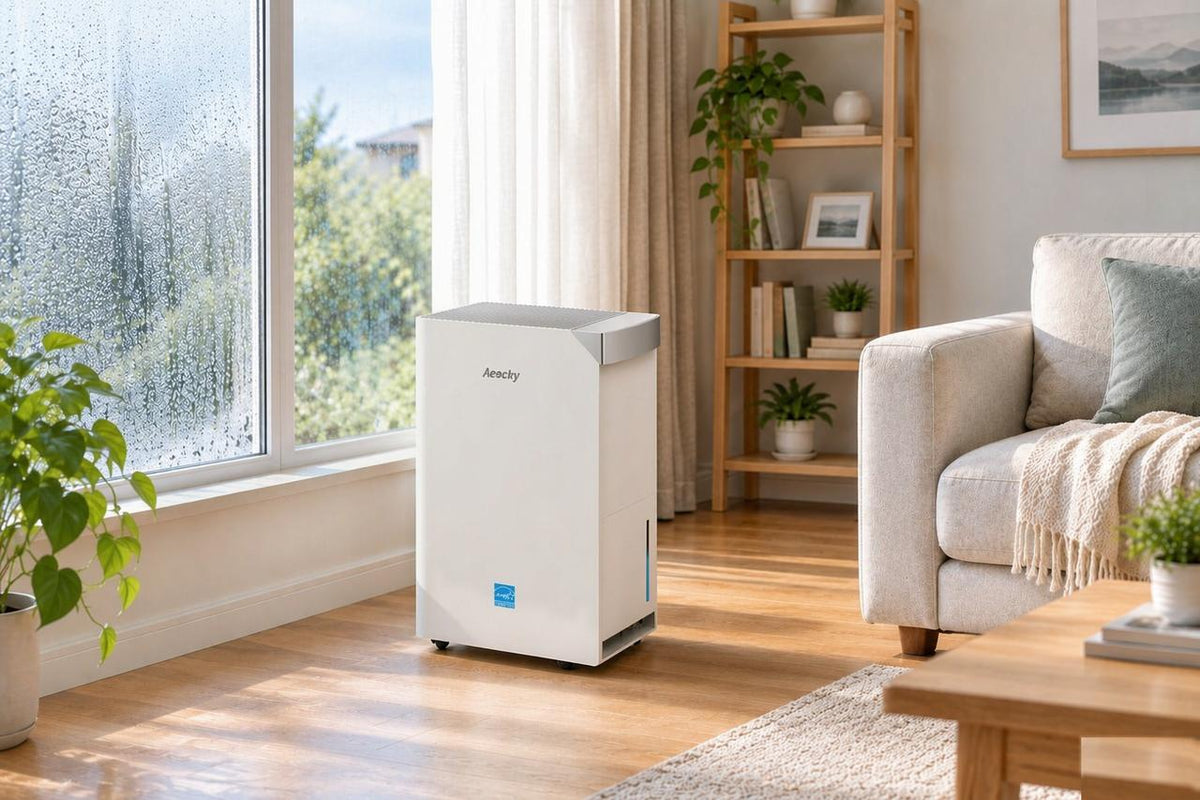
basement dehumidifier

How to Choose a Dehumidifier: A Practical Guide to Finding the Right Size

How to Choose a Dehumidifier: A Practical Guide to Finding the Right Size
Choosing a dehumidifier starts with more than the size of your room. A small bedroom with mild humidity needs a different unit than a damp basement or large living area. The right choice depends on several factors, including room size, humidity level, dehumidification capacity, energy efficiency, drainage, and how you plan to use the unit. This guide walks you through each step so you can choose the right dehumidifier without paying for capacity or features you do not need.

Step 1: Measure the Room Before Choosing a Dehumidifier

Start by measuring the space where the dehumidifier will operate.
For a simple rectangular room:
Length × Width = Square Footage
For example, a 20-foot by 15-foot room has 300 square feet of floor area.
This number gives you a starting point for a dehumidifier size guide, but it should not be the only number you use. An enclosed bedroom, an unfinished basement, and an open living area can have very different moisture loads even when they have the same floor area.
Also consider connected spaces. If the door between two rooms usually stays open, moisture can move between them. In that case, choosing a dehumidifier based on only one room may leave the larger area too humid.

Step 2: Check How Humid the Room Is

Once you know the room size, check its humidity.
A hygrometer can measure relative humidity (RH), which is more useful than judging moisture by how the room feels. If you notice condensation, damp walls, musty odors, or consistently high humidity, the room may need more dehumidification capacity.
The moisture level matters because two rooms of the same size may need different dehumidifiers. A mildly damp room does not put the same demand on a unit as a wet basement.
For ongoing moisture problems, it also helps to find the source. Poor ventilation, plumbing leaks, water intrusion, or inadequate drainage may need to be addressed separately. A dehumidifier can remove moisture from the air, but it should not be treated as a fix for a structural water problem.

Step 3: Match Dehumidifier Capacity to Your Room

This is the most important part of choosing a dehumidifier.

What Does Pint Capacity Mean?

Dehumidifier capacity is commonly expressed in pints of water removed per 24 hours. A higher pint rating generally means the unit can remove more moisture under its rated test conditions.
But do not compare pint ratings without checking the conditions behind the rating. Room size, humidity, temperature, and the actual moisture load all affect performance.

Use Room Size and Humidity Together

A practical approach is:
Room size + humidity level → required capacity
For a smaller room with moderate humidity, a lower-capacity unit may be enough. Larger rooms or spaces with heavier moisture loads generally require more capacity.
For example, AEOCKY currently lists its Arion series at up to 50 pints per day and up to 3,000 square feet of coverage, while its larger Rhea and Leo series offer models with substantially higher capacities for larger spaces. These published coverage figures are product specifications, not a guarantee that one unit will perform the same way in every room.

What Happens If the Dehumidifier Is Too Small?

An undersized unit may need to run for long periods and still struggle to bring humidity down to your target level. It may also be less practical in a space with a high moisture load.

Is a Bigger Dehumidifier Always Better?

Not necessarily.
A larger unit can provide more moisture-removal capacity, but you should still match the product to the space. Oversizing may mean paying for capacity you rarely need. Size, noise, energy use, airflow, and available space should all be considered before buying.

Step 4: Choose a Dehumidifier for the Room You Actually Have

Different rooms create different requirements.

Bedroom

If you need a dehumidifier for a bedroom, noise should be high on your list. Look for adjustable humidity control and a sleep or low-noise mode if the unit will run overnight.

Basement

Basements often have a higher and more persistent moisture load. When choosing a basement dehumidifier, consider capacity, drainage, low-temperature operation, and whether the unit can run for long periods.
Drainage is particularly important. If the basement stays humid for much of the year, continuously emptying a water tank can become inconvenient.

Bathroom or Laundry Room

Bathrooms and laundry areas can experience short periods of high moisture. Placement, drainage, and the unit's ability to respond to changing humidity may matter more than simply choosing the largest available model.
For anyone looking for a dehumidifier for mold prevention, humidity control is one part of the solution. Keeping moisture levels under control can help reduce conditions that support mold growth, but existing mold or water leaks still need to be addressed separately.

Step 5: Look for an Energy-Efficient Dehumidifier

A dehumidifier may operate for hours at a time, so energy efficiency matters when you are buying one for regular use.
Look for recognized efficiency information rather than focusing only on the purchase price. ENERGY STAR uses measures such as Integrated Energy Factor (IEF) to evaluate dehumidifier efficiency.
An energy efficient dehumidifier can make more sense for spaces that require frequent or extended operation. A useful comparison is not just the upfront price, but also how much energy the unit uses over time.
AEOCKY's current Energy Stars collection includes models marketed with ENERGY STAR certifications or ENERGY STAR Most Efficient designations, depending on the model. Check the specific model's current certification and specifications before making a purchase.

Step 6: Decide How You Want to Drain the Water

Water removal does not end when the dehumidifier collects moisture. You also need a practical way to get that water out of the unit.

Water Tank

A built-in tank works well when the unit is used occasionally or when emptying the tank is convenient.

Continuous Drainage

A drain hose can be more practical for a basement, laundry area, or other space where the dehumidifier may operate for long periods.
Some AEOCKY models, including the Rhea and Arion series, list continuous gravity drainage with a drain hose.

Built-In Drain Pump

A pump can be useful when the drainage point is higher than the dehumidifier. The AEOCKY Leo series currently lists a built-in drain pump, making drainage a key feature to consider when comparing units for basement or home use.

Step 7: Check the Features You Will Actually Use

Once capacity and drainage are sorted out, look at the extra features.
Useful options may include:
  • Adjustable humidistat
  • Auto humidity control
  • Multiple fan speeds
  • Auto shut-off
  • Continuous mode
  • Sleep mode
  • Auto defrost
  • Washable or replaceable filters
  • Timer or scheduling functions
The right feature set depends on the room. A bedroom may benefit more from quiet operation, while a basement may benefit more from continuous drainage and low-temperature operation.
Do not choose a model simply because it has the longest feature list. Focus on functions that solve a problem you actually have.

Step 8: Compare Your Options Before Buying a Dehumidifier

Before buying a dehumidifier, run through this checklist:
  • What is the room's square footage?
  • How humid is the space?
  • How much capacity do I need?
  • Is the room a bedroom, basement, bathroom, or open living area?
  • How often will the unit run?
  • Do I need continuous drainage?
  • Is energy efficiency important for my expected runtime?
  • How much noise can I tolerate?
  • Does the unit support the humidity range I want?
A quick comparison can prevent two common mistakes: choosing a unit that is too small for the moisture load or paying for capacity and features you will rarely use.

AEOCKY Dehumidifier Options for Different Spaces

If you are comparing AEOCKY models, the current product range covers several capacity and drainage configurations.
For larger spaces, the AEOCKY Rhea Series lists models ranging from up to 80 to 140 pints per day, with published coverage of up to 5,500 to 8,000 square feet depending on the model. It also lists ENERGY STAR Most Efficient 2025, smart auto-humidity, continuous gravity drainage, and quiet operation.
For spaces where pumped drainage is useful, the AEOCKY Leo Series lists a built-in drain pump and models reaching up to 140 pints per day and 8,000 square feet of published coverage.
For buyers focused on energy efficiency, the AEOCKY Leo-Lite Series lists ENERGY STAR Certified 2025 models, smart auto-humidity, continuous gravity drainage, and published coverage of up to 5,500 square feet depending on the model.
For a more portable option, the AEOCKY Arion currently lists up to 50 pints per day, up to 3,000 square feet of coverage, continuous gravity drainage, and a portable design.

Common Mistakes to Avoid When Choosing a Dehumidifier

Choosing Only by Square Footage

Room size is important, but humidity and room conditions also affect the required capacity.

Buying the Cheapest Model

The purchase price is only one part of the cost. Energy use, maintenance, drainage, and expected runtime also matter.

Ignoring Drainage

A tank may be fine for occasional use. For a damp basement, continuous drainage can save a lot of routine work.

Ignoring Noise

A unit that works well but is too loud for your bedroom or living area may not be a practical choice.

Assuming Bigger Is Always Better

The goal is not to buy the largest dehumidifier available. It is to match capacity and features to the room and moisture load.

Final Thoughts

The best way to choose a dehumidifier is to work through the problem in order. Measure the room, check its humidity, match the capacity to the moisture load, then consider the room type, energy efficiency, drainage, and features you will actually use. A larger capacity can make sense for a large or very damp space, while a smaller unit may be more practical elsewhere. Once you know these requirements, comparing models becomes much simpler—and you can focus on finding a dehumidifier that fits your space rather than simply choosing the biggest one.
 

Reading next

What Size Dehumidifier Do I Need?

Leave a comment

This site is protected by hCaptcha and the hCaptcha Privacy Policy and Terms of Service apply.

How to Choose a Dehumidifier: A Practical Guide to Finding the Right Size

Choosing a dehumidifier starts with more than the size of your room. A small bedroom with mild humidity needs a different unit than a damp basement or large living area. The right choice depends on several factors, including room size, humidity level, dehumidification capacity, energy efficiency, drainage, and how you plan to use the unit. This guide walks you through each step so you can choose the right dehumidifier without paying for capacity or features you do not need.

Step 1: Measure the Room Before Choosing a Dehumidifier

Start by measuring the space where the dehumidifier will operate.
For a simple rectangular room:
Length × Width = Square Footage
For example, a 20-foot by 15-foot room has 300 square feet of floor area.
This number gives you a starting point for a dehumidifier size guide, but it should not be the only number you use. An enclosed bedroom, an unfinished basement, and an open living area can have very different moisture loads even when they have the same floor area.
Also consider connected spaces. If the door between two rooms usually stays open, moisture can move between them. In that case, choosing a dehumidifier based on only one room may leave the larger area too humid.

Step 2: Check How Humid the Room Is

Once you know the room size, check its humidity.
A hygrometer can measure relative humidity (RH), which is more useful than judging moisture by how the room feels. If you notice condensation, damp walls, musty odors, or consistently high humidity, the room may need more dehumidification capacity.
The moisture level matters because two rooms of the same size may need different dehumidifiers. A mildly damp room does not put the same demand on a unit as a wet basement.
For ongoing moisture problems, it also helps to find the source. Poor ventilation, plumbing leaks, water intrusion, or inadequate drainage may need to be addressed separately. A dehumidifier can remove moisture from the air, but it should not be treated as a fix for a structural water problem.

Step 3: Match Dehumidifier Capacity to Your Room

This is the most important part of choosing a dehumidifier.

What Does Pint Capacity Mean?

Dehumidifier capacity is commonly expressed in pints of water removed per 24 hours. A higher pint rating generally means the unit can remove more moisture under its rated test conditions.
But do not compare pint ratings without checking the conditions behind the rating. Room size, humidity, temperature, and the actual moisture load all affect performance.

Use Room Size and Humidity Together

A practical approach is:
Room size + humidity level → required capacity
For a smaller room with moderate humidity, a lower-capacity unit may be enough. Larger rooms or spaces with heavier moisture loads generally require more capacity.
For example, AEOCKY currently lists its Arion series at up to 50 pints per day and up to 3,000 square feet of coverage, while its larger Rhea and Leo series offer models with substantially higher capacities for larger spaces. These published coverage figures are product specifications, not a guarantee that one unit will perform the same way in every room.

What Happens If the Dehumidifier Is Too Small?

An undersized unit may need to run for long periods and still struggle to bring humidity down to your target level. It may also be less practical in a space with a high moisture load.

Is a Bigger Dehumidifier Always Better?

Not necessarily.
A larger unit can provide more moisture-removal capacity, but you should still match the product to the space. Oversizing may mean paying for capacity you rarely need. Size, noise, energy use, airflow, and available space should all be considered before buying.

Step 4: Choose a Dehumidifier for the Room You Actually Have

Different rooms create different requirements.

Bedroom

If you need a dehumidifier for a bedroom, noise should be high on your list. Look for adjustable humidity control and a sleep or low-noise mode if the unit will run overnight.

Basement

Basements often have a higher and more persistent moisture load. When choosing a basement dehumidifier, consider capacity, drainage, low-temperature operation, and whether the unit can run for long periods.
Drainage is particularly important. If the basement stays humid for much of the year, continuously emptying a water tank can become inconvenient.

Bathroom or Laundry Room

Bathrooms and laundry areas can experience short periods of high moisture. Placement, drainage, and the unit's ability to respond to changing humidity may matter more than simply choosing the largest available model.
For anyone looking for a dehumidifier for mold prevention, humidity control is one part of the solution. Keeping moisture levels under control can help reduce conditions that support mold growth, but existing mold or water leaks still need to be addressed separately.

Step 5: Look for an Energy-Efficient Dehumidifier

A dehumidifier may operate for hours at a time, so energy efficiency matters when you are buying one for regular use.
Look for recognized efficiency information rather than focusing only on the purchase price. ENERGY STAR uses measures such as Integrated Energy Factor (IEF) to evaluate dehumidifier efficiency.
An energy efficient dehumidifier can make more sense for spaces that require frequent or extended operation. A useful comparison is not just the upfront price, but also how much energy the unit uses over time.
AEOCKY's current Energy Stars collection includes models marketed with ENERGY STAR certifications or ENERGY STAR Most Efficient designations, depending on the model. Check the specific model's current certification and specifications before making a purchase.

Step 6: Decide How You Want to Drain the Water

Water removal does not end when the dehumidifier collects moisture. You also need a practical way to get that water out of the unit.

Water Tank

A built-in tank works well when the unit is used occasionally or when emptying the tank is convenient.

Continuous Drainage

A drain hose can be more practical for a basement, laundry area, or other space where the dehumidifier may operate for long periods.
Some AEOCKY models, including the Rhea and Arion series, list continuous gravity drainage with a drain hose.

Built-In Drain Pump

A pump can be useful when the drainage point is higher than the dehumidifier. The AEOCKY Leo series currently lists a built-in drain pump, making drainage a key feature to consider when comparing units for basement or home use.

Step 7: Check the Features You Will Actually Use

Once capacity and drainage are sorted out, look at the extra features.
Useful options may include:
  • Adjustable humidistat
  • Auto humidity control
  • Multiple fan speeds
  • Auto shut-off
  • Continuous mode
  • Sleep mode
  • Auto defrost
  • Washable or replaceable filters
  • Timer or scheduling functions
The right feature set depends on the room. A bedroom may benefit more from quiet operation, while a basement may benefit more from continuous drainage and low-temperature operation.
Do not choose a model simply because it has the longest feature list. Focus on functions that solve a problem you actually have.

Step 8: Compare Your Options Before Buying a Dehumidifier

Before buying a dehumidifier, run through this checklist:
  • What is the room's square footage?
  • How humid is the space?
  • How much capacity do I need?
  • Is the room a bedroom, basement, bathroom, or open living area?
  • How often will the unit run?
  • Do I need continuous drainage?
  • Is energy efficiency important for my expected runtime?
  • How much noise can I tolerate?
  • Does the unit support the humidity range I want?
A quick comparison can prevent two common mistakes: choosing a unit that is too small for the moisture load or paying for capacity and features you will rarely use.

AEOCKY Dehumidifier Options for Different Spaces

If you are comparing AEOCKY models, the current product range covers several capacity and drainage configurations.
For larger spaces, the AEOCKY Rhea Series lists models ranging from up to 80 to 140 pints per day, with published coverage of up to 5,500 to 8,000 square feet depending on the model. It also lists ENERGY STAR Most Efficient 2025, smart auto-humidity, continuous gravity drainage, and quiet operation.
For spaces where pumped drainage is useful, the AEOCKY Leo Series lists a built-in drain pump and models reaching up to 140 pints per day and 8,000 square feet of published coverage.
For buyers focused on energy efficiency, the AEOCKY Leo-Lite Series lists ENERGY STAR Certified 2025 models, smart auto-humidity, continuous gravity drainage, and published coverage of up to 5,500 square feet depending on the model.
For a more portable option, the AEOCKY Arion currently lists up to 50 pints per day, up to 3,000 square feet of coverage, continuous gravity drainage, and a portable design.

Common Mistakes to Avoid When Choosing a Dehumidifier

Choosing Only by Square Footage

Room size is important, but humidity and room conditions also affect the required capacity.

Buying the Cheapest Model

The purchase price is only one part of the cost. Energy use, maintenance, drainage, and expected runtime also matter.

Ignoring Drainage

A tank may be fine for occasional use. For a damp basement, continuous drainage can save a lot of routine work.

Ignoring Noise

A unit that works well but is too loud for your bedroom or living area may not be a practical choice.

Assuming Bigger Is Always Better

The goal is not to buy the largest dehumidifier available. It is to match capacity and features to the room and moisture load.

Final Thoughts

The best way to choose a dehumidifier is to work through the problem in order. Measure the room, check its humidity, match the capacity to the moisture load, then consider the room type, energy efficiency, drainage, and features you will actually use. A larger capacity can make sense for a large or very damp space, while a smaller unit may be more practical elsewhere. Once you know these requirements, comparing models becomes much simpler—and you can focus on finding a dehumidifier that fits your space rather than simply choosing the biggest one.