


A dehumidifier’s pints-per-day rating tells you how much moisture it can remove from the air over 24 hours under specified test conditions. It does not describe the size of its water tank, guarantee how much water it will collect in your home, or directly tell you how many square feet it can handle. Understanding dehumidifier pints per day makes it easier to compare models fairly. Read the rating alongside room conditions, moisture sources, and drainage options.
What Does Pints per Day Mean on a Dehumidifier?
“Pints per day,” often shortened to PPD, measures moisture-removal capacity. A unit rated at 30 pints per day can remove up to 30 US pints of water from the air in 24 hours under the conditions used for its capacity test. That is about 3.75 gallons.
The rating is a comparison point, not a daily forecast. A cool, relatively dry room usually yields less collected water than a hot, humid one.
Why Testing Conditions Matter
A capacity number only makes sense when you know how it was measured. The U.S. Department of Energy changed its dehumidifier testing procedure around 2019–2020 to use cooler conditions for portable units, closer to those found in many basements. Cooler air contains less moisture, so capacity ratings for comparable machines often became lower under the newer method. A newer 30-pint rating should not automatically be treated as weaker than an older 50-pint rating without checking the test basis. ENERGY STAR explains the change in its dehumidifier testing and capacity guidance.
A clear explanation of dehumidifier pints per day should include both the number and its test context. Compare current models using the same standard, then review efficiency and operating range.
Dehumidifier Pints per Day Under Real Conditions
The rated capacity helps compare machines, but everyday results depend on the space where the unit runs. Several factors affect how much water reaches the bucket or drain.
-
Temperature: Refrigerant dehumidifiers generally remove less moisture as the air gets cooler, and some models may need to defrost in low temperatures. Check the specified operating range.
-
Relative humidity: Air at 80% relative humidity usually offers more moisture to remove than air at 50%, so water collection can be higher when the room starts out very damp.
-
Room size and layout: A large, open area or a space divided by walls may be harder to dry evenly than a smaller, open room.
-
Moisture sources: Laundry drying, showers, damp foundations, open windows, or water leaks can add moisture while the unit is running.
-
Airflow and placement: Keep the air inlet and outlet clear and follow the manufacturer’s recommended spacing. Restricted airflow can affect performance.
For example, a basement that begins very damp may produce a noticeable amount of collected water during the first few days. As humidity falls toward the set point, the compressor may run less often and the bucket may fill more slowly. That change does not automatically mean the machine has stopped working.
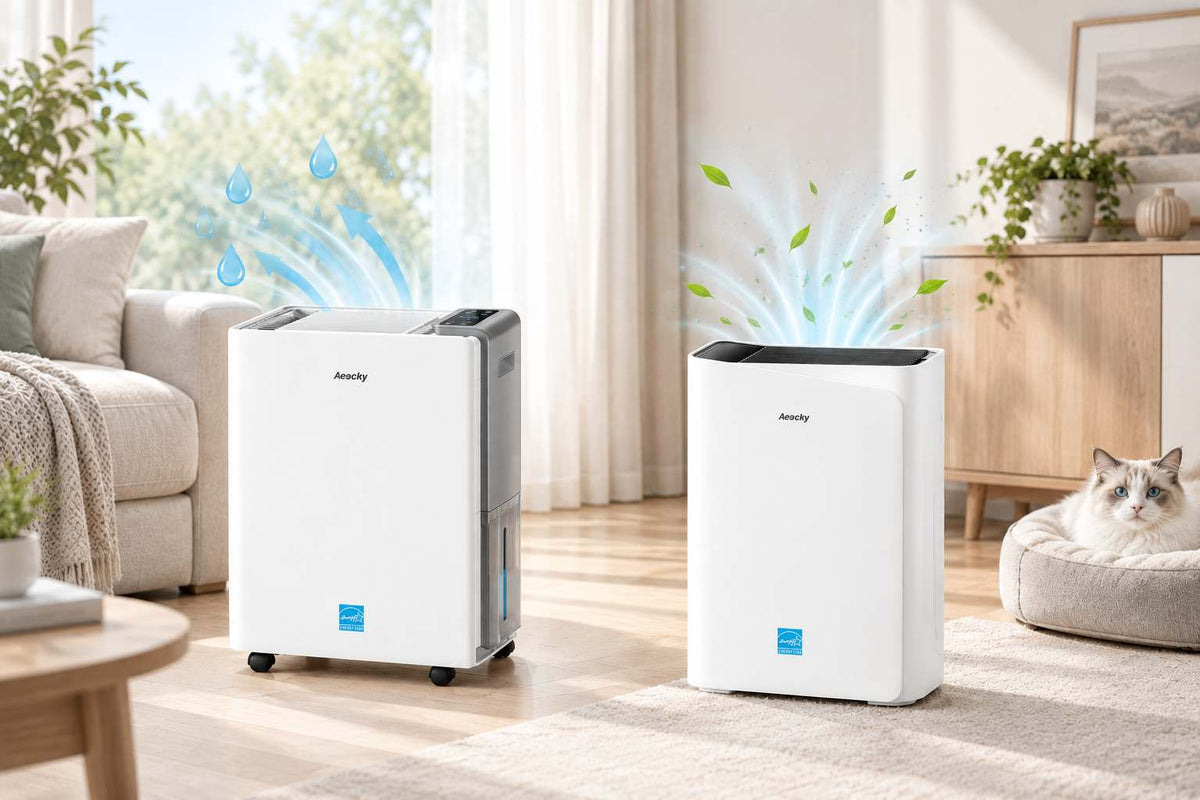
For large or persistently damp areas, compare capacity with the space and its moisture load. The Aeocky Rhea Series dehumidifier is one product line to review for larger home and basement applications. Check the selected model’s stated capacity and the conditions attached to that figure rather than assuming every model in a series has the same output.
Pints per Day vs. Water Tank Capacity
The difference between dehumidifier pints per day and tank capacity is straightforward: one measures how much moisture the machine can remove over time; the other measures how much water its reservoir can hold before it needs to be emptied.
| Specification | What it tells you | Why it matters |
| Pints per day | Moisture-removal capacity over 24 hours under stated test conditions | Helps compare dehumidifier performance |
| Tank capacity | Amount of water the reservoir can store | Affects how often you need to empty it |
| Drainage option | How collected water leaves the unit | Can reduce manual emptying during long operation |
| Energy efficiency | Moisture removed relative to energy used | Helps compare operating efficiency |
A 30-pint-per-day unit does not need a 30-pint tank. If its reservoir is much smaller, it may fill and shut off before the day is over, especially in a damp room. A continuous drain hose can reduce the need to empty the tank manually, provided the unit supports it and the drain is installed according to the instructions. Some models also include a pump for situations where water must be moved upward to a drain.
How to Choose the Right Dehumidifier Capacity
Start with the size of the area, then consider how damp it is. A mildly damp bedroom and a basement with wet surfaces have different moisture loads even if they have the same floor area. ENERGY STAR’s buying guidance groups capacity recommendations by both room size and dampness level, so use its chart as a starting point rather than relying on square footage alone.
Next, consider how the room is used. Laundry rooms and spaces with ongoing moisture sources may need more capacity than a dry room of similar size. If you are comparing models, look beyond the headline pint number: check the applicable test standard, energy-efficiency rating, noise level, operating temperature range, and whether the tank, gravity drain, or pump suits your setup.
For a large room, basement, or whole-home application, compare products designed for that type of space. The Aeocky Rhea Series lists different models with different maximum capacity figures, and the product page specifies the conditions for those maximum figures. Match the exact model to your requirements and confirm its published specifications before buying.
Frequently Asked Questions
Does a Higher Pint Rating Always Mean Better Performance?
No. A higher rating indicates greater moisture-removal capacity under the stated test conditions, but it does not automatically mean better energy efficiency, quieter operation, or a better fit for every room. Choose capacity based on the moisture load and compare efficiency and features as well.
Why Does My Dehumidifier Collect Less Water Than Expected?
The room may already be close to its target humidity, the temperature may be low, or there may be less moisture in the air than when the unit was first switched on. Check the humidity setting, filter, airflow clearance, and operating-temperature range. If performance remains unusually low, consult the manual or manufacturer support.
Final Thoughts
A pints-per-day rating is a useful way to compare dehumidifiers, as long as you understand what it measures. It describes moisture removal over 24 hours under specified test conditions—not tank size or a guaranteed daily collection amount in every home. For a realistic comparison, consider temperature, humidity, room layout, and ongoing moisture sources alongside the published capacity. Then check energy efficiency and drainage options to see whether the unit fits your space and routine. Reading the full specification, rather than relying on one number, will help you choose a dehumidifier that matches the job.


Leave a comment
This site is protected by hCaptcha and the hCaptcha Privacy Policy and Terms of Service apply.