

control moisture

Dehumidifier with a Humidistat: Is It Worth

Dehumidifier with a Humidistat: Is It Worth
A dehumidifier with a humidistat is worth considering if you want to keep indoor humidity within a target range without repeatedly checking the controls. A humidistat measures relative humidity and lets the unit adjust its operation when the air reaches the setting you choose. That can make moisture control more convenient and may reduce unnecessary runtime. It does not guarantee lower electricity bills, though. Results depend on the room’s moisture load, the dehumidifier’s efficiency, the accuracy of its sensor, and how you use it. Here is how the feature works and when it is worth paying for.

What Is a Humidistat on a Dehumidifier?

A humidistat is a control that measures relative humidity (RH), the amount of moisture in the air compared with the maximum amount the air can hold at that temperature. A dehumidifier with a built-in humidistat uses that reading to guide its operation.
For example, you might set the target to 50% RH. When the room is more humid than the target, the unit runs to remove moisture. Once humidity falls to the set level, it may stop the compressor or switch to standby. If humidity rises again, it can restart automatically, depending on the model.
A humidistat differs from a timer, which runs for a set period regardless of room humidity. Some models display current RH; others offer simpler controls, so check the specifications.

How Does a Dehumidifier with a Humidistat Work?

The sensor checks relative humidity and compares it with your target. The unit then runs, pauses, or changes modes according to its design.
Controls vary by model: some allow precise RH settings, while others use preset modes. Sensor placement, airflow, temperature, and calibration can affect readings, so treat the displayed number as a guide.
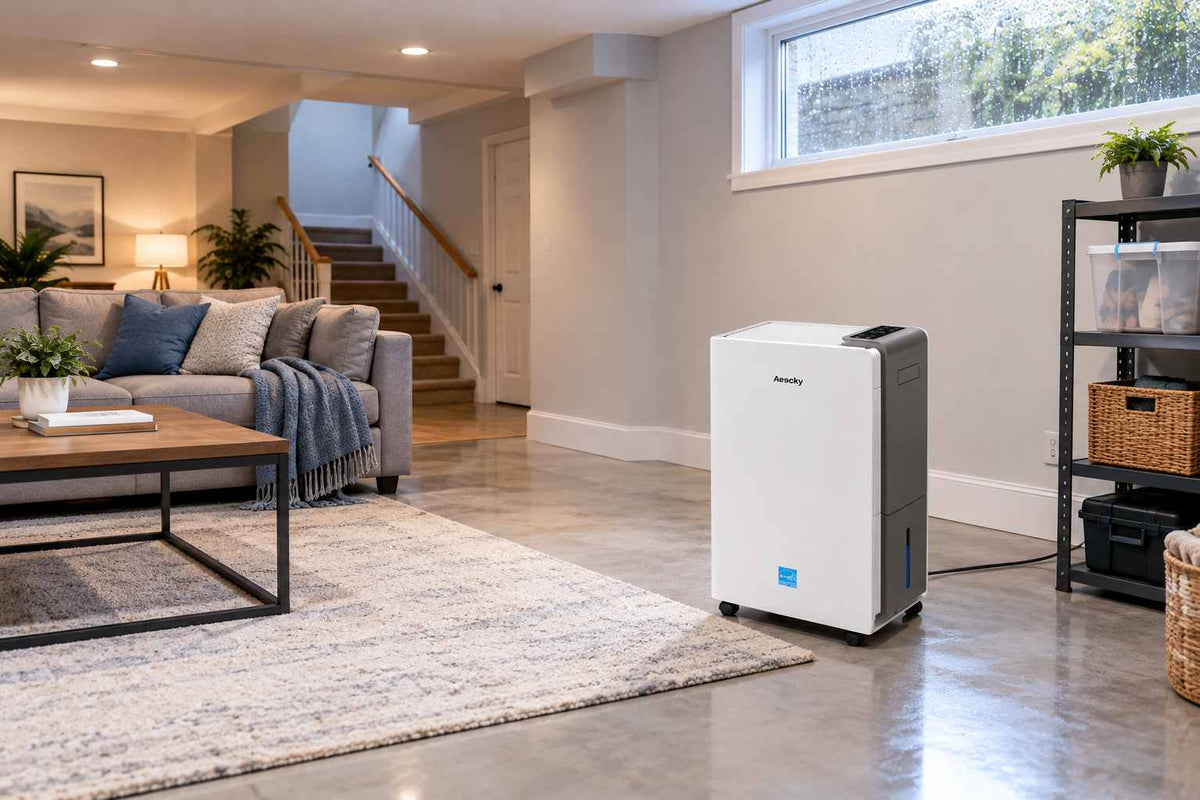
For example, the Aeocky Rhea series offers automatic humidity control and adjustable settings, making it one option to compare if you want to set a target humidity level with a dehumidifier. Check the specifications of the exact model you are considering; features can differ across a product range.

Benefits of a Dehumidifier with a Humidistat

More Consistent Humidity Control

A humidistat helps maintain a target instead of relying on guesswork. Many homes aim for 30% to 50% RH, though the best setting depends on the home and season. Automatic control can help when condensation or musty odors recur.

Less Unnecessary Runtime

Without humidity-based control, you may run a unit longer than necessary or switch it on and off manually. A humidistat can stop active dehumidification once the target is reached and restart it if moisture builds up again. That reduces the need for constant supervision.

Less Need for Manual Adjustments

Humidity changes with cooking, showers, laundry, and weather. Automatic control responds to some fluctuations, though persistent dampness, leaks, or condensation still need attention.

Does a Dehumidifier with a Humidistat Save Energy?

It can, but the humidistat itself does not make a dehumidifier inherently energy-efficient. It helps by matching operation to the room’s moisture level. If a unit would otherwise run longer than needed, automatic shutoff may reduce operating time and electricity use.
Savings depend on efficiency, moisture load, room size, target RH, and how often doors or windows are open. A damp basement with water intrusion may still require frequent operation.
Choose a correctly sized unit, fix leaks, clean the filter as directed, and avoid an unnecessarily low target. Compare model-specific energy information instead of assuming every humidistat-equipped unit uses less electricity.

Do I Need a Dehumidifier with a Built-In Humidistat?

A built-in humidistat is useful in basements, laundry areas, or rooms that become damp seasonally. It can also help during unattended operation when the unit and drainage setup are suitable.
You may not need it for occasional short tasks if manual control is fine. A separate hygrometer measures RH but will not control the unit unless compatible.
If you are comparing larger models, the Aeocky Leo series with a built-in drain pump combines automatic humidity control with a pump for situations where gravity drainage is inconvenient. The pump and humidistat serve different purposes: one handles collected water, while the other helps regulate operation. Confirm the feature list for your chosen model.

What to Check Before Buying

Do not choose by the word “humidistat” alone. Check:
  • Adjustment range: Can you select the RH target you want, or are you limited to preset modes?
  • Display and readability: Does the unit show current humidity as well as the target?
  • Sensor behavior: Look for clear instructions on control settings and any stated accuracy.
  • Capacity and room conditions: Match the unit to the space and the moisture load, not just the advertised maximum coverage.
  • Drainage: Consider a tank, gravity drain, or pump based on where the unit will sit.
  • Energy performance and noise: Compare model-specific information and consider how often it will run.
A humidistat cannot compensate for an undersized unit, blocked airflow, leaks, or foundation water intrusion.

Frequently Asked Questions

Is a dehumidifier with a humidistat worth it?

For regular use, usually yes. It makes humidity control more automatic and can prevent some unnecessary runtime. The value is lower if you use the unit only occasionally and do not mind managing it manually.

How does a dehumidifier with a humidistat work?

It measures relative humidity and compares the reading with your chosen target. Depending on the model, it runs or pauses dehumidification to keep the room near that setting.

Does a dehumidifier with a humidistat save energy?

It may reduce energy use by avoiding operation after the target is reached, but savings vary with room conditions, unit efficiency, and settings. A humidistat is not a substitute for choosing an appropriately sized, efficient model.

What humidity should I set?

A common starting point for many homes is around 30% to 50% RH. Adjust for comfort, condensation, local conditions, and manufacturer guidance. If dampness persists, investigate the moisture source rather than relying on a lower setting alone.

Final Thoughts

A dehumidifier with a humidistat is often worth it when you want steady humidity control with less manual attention. It measures moisture levels and helps the unit run when needed, which may also reduce unnecessary operating time. But the feature is only one part of the decision. Capacity, energy performance, drainage, sensor behavior, and the room’s moisture source matter just as much. If you use a dehumidifier regularly in a basement or other damp space, automatic humidity control can be a practical convenience. Compare the specifications of individual models and choose a target that suits your home rather than expecting the humidistat alone to solve every moisture problem.
 

Reading next

Can You Use a Dehumidifier in an Unheated Room? Temperature Limits Explained
Dehumidifier vs. Moisture Absorber: Which Is Better for Your Home?

Leave a comment

This site is protected by hCaptcha and the hCaptcha Privacy Policy and Terms of Service apply.

Dehumidifier with a Humidistat: Is It Worth

A dehumidifier with a humidistat is worth considering if you want to keep indoor humidity within a target range without repeatedly checking the controls. A humidistat measures relative humidity and lets the unit adjust its operation when the air reaches the setting you choose. That can make moisture control more convenient and may reduce unnecessary runtime. It does not guarantee lower electricity bills, though. Results depend on the room’s moisture load, the dehumidifier’s efficiency, the accuracy of its sensor, and how you use it. Here is how the feature works and when it is worth paying for.

What Is a Humidistat on a Dehumidifier?

A humidistat is a control that measures relative humidity (RH), the amount of moisture in the air compared with the maximum amount the air can hold at that temperature. A dehumidifier with a built-in humidistat uses that reading to guide its operation.
For example, you might set the target to 50% RH. When the room is more humid than the target, the unit runs to remove moisture. Once humidity falls to the set level, it may stop the compressor or switch to standby. If humidity rises again, it can restart automatically, depending on the model.
A humidistat differs from a timer, which runs for a set period regardless of room humidity. Some models display current RH; others offer simpler controls, so check the specifications.

How Does a Dehumidifier with a Humidistat Work?

The sensor checks relative humidity and compares it with your target. The unit then runs, pauses, or changes modes according to its design.
Controls vary by model: some allow precise RH settings, while others use preset modes. Sensor placement, airflow, temperature, and calibration can affect readings, so treat the displayed number as a guide.
For example, the Aeocky Rhea series offers automatic humidity control and adjustable settings, making it one option to compare if you want to set a target humidity level with a dehumidifier. Check the specifications of the exact model you are considering; features can differ across a product range.

Benefits of a Dehumidifier with a Humidistat

More Consistent Humidity Control

A humidistat helps maintain a target instead of relying on guesswork. Many homes aim for 30% to 50% RH, though the best setting depends on the home and season. Automatic control can help when condensation or musty odors recur.

Less Unnecessary Runtime

Without humidity-based control, you may run a unit longer than necessary or switch it on and off manually. A humidistat can stop active dehumidification once the target is reached and restart it if moisture builds up again. That reduces the need for constant supervision.

Less Need for Manual Adjustments

Humidity changes with cooking, showers, laundry, and weather. Automatic control responds to some fluctuations, though persistent dampness, leaks, or condensation still need attention.

Does a Dehumidifier with a Humidistat Save Energy?

It can, but the humidistat itself does not make a dehumidifier inherently energy-efficient. It helps by matching operation to the room’s moisture level. If a unit would otherwise run longer than needed, automatic shutoff may reduce operating time and electricity use.
Savings depend on efficiency, moisture load, room size, target RH, and how often doors or windows are open. A damp basement with water intrusion may still require frequent operation.
Choose a correctly sized unit, fix leaks, clean the filter as directed, and avoid an unnecessarily low target. Compare model-specific energy information instead of assuming every humidistat-equipped unit uses less electricity.

Do I Need a Dehumidifier with a Built-In Humidistat?

A built-in humidistat is useful in basements, laundry areas, or rooms that become damp seasonally. It can also help during unattended operation when the unit and drainage setup are suitable.
You may not need it for occasional short tasks if manual control is fine. A separate hygrometer measures RH but will not control the unit unless compatible.
If you are comparing larger models, the Aeocky Leo series with a built-in drain pump combines automatic humidity control with a pump for situations where gravity drainage is inconvenient. The pump and humidistat serve different purposes: one handles collected water, while the other helps regulate operation. Confirm the feature list for your chosen model.

What to Check Before Buying

Do not choose by the word “humidistat” alone. Check:
  • Adjustment range: Can you select the RH target you want, or are you limited to preset modes?
  • Display and readability: Does the unit show current humidity as well as the target?
  • Sensor behavior: Look for clear instructions on control settings and any stated accuracy.
  • Capacity and room conditions: Match the unit to the space and the moisture load, not just the advertised maximum coverage.
  • Drainage: Consider a tank, gravity drain, or pump based on where the unit will sit.
  • Energy performance and noise: Compare model-specific information and consider how often it will run.
A humidistat cannot compensate for an undersized unit, blocked airflow, leaks, or foundation water intrusion.

Frequently Asked Questions

Is a dehumidifier with a humidistat worth it?

For regular use, usually yes. It makes humidity control more automatic and can prevent some unnecessary runtime. The value is lower if you use the unit only occasionally and do not mind managing it manually.

How does a dehumidifier with a humidistat work?

It measures relative humidity and compares the reading with your chosen target. Depending on the model, it runs or pauses dehumidification to keep the room near that setting.

Does a dehumidifier with a humidistat save energy?

It may reduce energy use by avoiding operation after the target is reached, but savings vary with room conditions, unit efficiency, and settings. A humidistat is not a substitute for choosing an appropriately sized, efficient model.

What humidity should I set?

A common starting point for many homes is around 30% to 50% RH. Adjust for comfort, condensation, local conditions, and manufacturer guidance. If dampness persists, investigate the moisture source rather than relying on a lower setting alone.

Final Thoughts

A dehumidifier with a humidistat is often worth it when you want steady humidity control with less manual attention. It measures moisture levels and helps the unit run when needed, which may also reduce unnecessary operating time. But the feature is only one part of the decision. Capacity, energy performance, drainage, sensor behavior, and the room’s moisture source matter just as much. If you use a dehumidifier regularly in a basement or other damp space, automatic humidity control can be a practical convenience. Compare the specifications of individual models and choose a target that suits your home rather than expecting the humidistat alone to solve every moisture problem.


Popular Posts
Dehumidifier Water Tank Capacity: How Often Will You Need to Empty It?
How to Protect Cardboard Boxes and Stored Belongings from Humidity
Can a Dehumidifier Help Clothes Dry Faster Indoors?
Dehumidifier Capacity Loss Over Time: What Affects Long-Term Performance?
AC Dry Mode vs. Dehumidifier: Which Is Better for Humidity Control?
Dehumidifier Pints per Day Explained: What Does the Rating Really Mean?
Dehumidifier vs. Air Purifier: Which One Does Your Home Need?
Dehumidifier vs. Moisture Absorber: Which Is Better for Your Home?
Dehumidifier with a Humidistat: Is It Worth
Can You Use a Dehumidifier in an Unheated Room? Temperature Limits Explained
Aeocky Dehumidifier Warranty, Returns & Replacement: What Buyers Should Know
Best Dehumidifier for a Home Office: Quiet, Compact & Efficient Options
Best Dehumidifier for Crawl Spaces: Size, Drainage & Humidity Control
Best Dehumidifier for RV Storage: How to Protect Your RV When It's Not in Use
Best Dehumidifier for Cars: How to Prevent Moisture, Foggy Windows & Musty Odors
Is It Okay to Sleep With a Dehumidifier On? Bedroom Safety Tips
Should I run my dehumidifier during the day or at night
How to Tell If Your House Needs a Dehumidifier: Signs of High Humidity
Should I Use a Dehumidifier in the Summer?
Dehumidifiers for Pet Owners: Reducing Odors, Dampness & Pet Dander
Subscribe Us
Subscribe to our newsletter and receive a selection of cool articles every weeks