

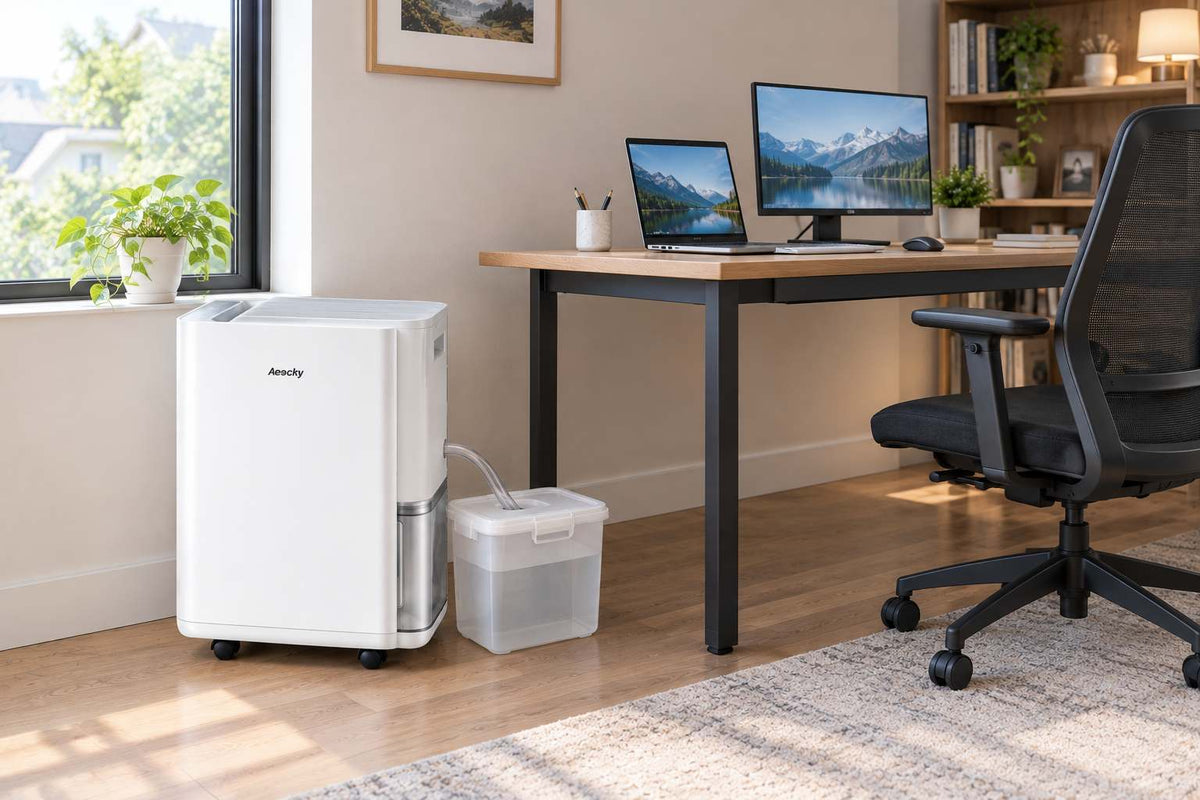
A dehumidifier can make a home office more comfortable when humidity stays high, especially in rooms with poor ventilation or during humid weather. But an office has different requirements from a basement or laundry room. Noise matters when you are working, taking calls, or recording meetings. Space matters when the room is already crowded with a desk, chair, monitor, and storage. Energy use matters too if the unit runs for several hours each day.
For most workspaces, the best dehumidifier for home office use is compact, quiet, easy to operate, and able to maintain a stable humidity level without constant attention.
Why Does a Home Office Need a Dehumidifier?
High indoor humidity can make a workspace feel warmer and less comfortable than the actual temperature suggests. Persistent moisture can also contribute to condensation, musty odors, and an environment where mold is more likely to develop.
A home office dehumidifier can remove excess moisture from the air and help maintain a more consistent indoor environment. If you are unsure what a dehumidifier actually does and how the process works, this explanation of how a dehumidifier works provides useful background.
For a typical office, the goal is not to make the room extremely dry. Instead, aim for a comfortable and stable relative humidity level appropriate for your home.
What Is the Best Dehumidifier for a Home Office?
The right choice depends on office size, moisture levels, and how sensitive you are to noise.
Small and Compact Options
For a small enclosed workspace, a compact dehumidifier for home office use is often the most practical option. A smaller unit takes up less floor space and can be easier to move when you rearrange your workspace.
The Aeocky Arion Small Portable Dehumidifier is one example worth considering when portability and compact placement are priorities. Its small form factor makes it more relevant to personal workspaces than a large whole-house model.
A small dehumidifier for office use is particularly useful when the room has a moderate moisture problem rather than severe or persistent humidity.
When You Need More Dehumidifying Capacity
A larger home office may need more moisture-removal capacity, particularly if it is located in a basement, has limited ventilation, or experiences consistently high humidity.
In that situation, choosing the best small dehumidifier for office use simply because it occupies less space may not solve the underlying problem. A properly sized unit can remove moisture more effectively and may not need to run continuously.
For larger spaces, capacity should be matched to room size and moisture load rather than judged by physical size alone.
Automatic Humidity Control
A dehumidifier with automatic humidity control can be especially convenient in a workspace. Instead of manually switching the unit on and off, the dehumidifier can respond to changes in room humidity according to its controls.
That matters when you spend long hours working. You can set your preferred humidity level and focus on your work instead of repeatedly checking the room.
What Features Matter Most in a Home Office Dehumidifier?
Quiet Operation
Noise is one of the biggest differences between a general-purpose dehumidifier and one intended for a workspace.
A quiet dehumidifier for home office use should produce as little distracting sound as possible, particularly if your work involves video calls, presentations, writing, or recording audio.
Searches for the quietest dehumidifier for office use often reflect a simple need: the unit should do its job without becoming another source of background noise.
Look for published noise information when available, but remember that perceived noise can also depend on fan speed, room acoustics, and how close the unit is to your desk.
Compact Size
A compact dehumidifier is easier to position in a home office, especially when floor space is limited. However, avoid placing it directly against walls, curtains, furniture, or other objects that restrict airflow.
A unit should have enough clearance for air to enter and leave properly. Putting a dehumidifier in a cramped corner simply to keep it out of sight can reduce its effectiveness.
Energy Efficiency
If the dehumidifier runs for several hours every day, energy consumption becomes an important consideration. An energy efficient dehumidifier for home office use can help reduce unnecessary electricity consumption while maintaining the desired humidity level.
Efficiency should be considered alongside moisture-removal capacity. A unit that is too small may need to run for much longer, so choosing the lowest-capacity model is not automatically the most economical decision.
Automatic Humidity Control
Automatic controls are useful for a dehumidifier for office humidity because humidity can change throughout the day. Weather, closed windows, occupancy, and heating or cooling can all affect indoor moisture levels.
A built-in humidistat or automatic setting can help maintain a more consistent environment without requiring constant manual adjustment.
How to Choose the Right Size Dehumidifier for an Office
Start with the size of the room, but do not stop there.
A small, enclosed office with mildly elevated humidity may work well with a compact unit. A larger office or a room connected to other spaces may require more capacity.
Also consider:
-
How humid the room becomes during the day
-
Whether the office is in a basement or lower level
-
Whether windows regularly develop condensation
-
How well the room is ventilated
-
Whether the door usually stays closed
-
How many hours the dehumidifier will run each day
If your office is part of a larger open area, sizing becomes more complicated. In that case, this guide on choosing a dehumidifier for large rooms can help explain the capacity question in more detail.
Where Should You Place a Home Office Dehumidifier?
Place the unit where it can circulate air freely. A location near the center or an open side of the room is generally preferable to a tightly enclosed corner.
Keep the air intake and outlet unobstructed, and avoid placing the unit where water from the tank could damage important equipment.
If your desk contains computers, monitors, printers, or other electronics, it is sensible to position the dehumidifier so that the airflow and collected water remain away from them.
How to Control Office Humidity While Working From Home
A dehumidifier for work from home is only one part of humidity management. If moisture enters the room through leaks, condensation, poor ventilation, or another source, the underlying problem should be addressed as well.
Start by measuring humidity with a hygrometer. Then use the dehumidifier to maintain a reasonable indoor level rather than running it continuously without a target.
For more information about appropriate indoor humidity, see this guide to the ideal indoor humidity level for a home.
It is also worth checking whether moisture is coming from outside the office. Improving ventilation when appropriate, fixing leaks, and keeping moisture-producing activities away from the workspace can reduce the workload on the dehumidifier.
Final Thoughts
The best dehumidifier for a home office is not necessarily the largest or most powerful model. For many workspaces, the better choice is a compact unit that operates quietly, uses energy reasonably, and can maintain humidity without constant manual adjustment.
Prioritize noise level if you spend long hours at your desk. Consider physical size when floor space is limited. And if humidity is consistently high, choose capacity based on both room size and moisture conditions rather than choosing a unit simply because it is small.
A well-sized home office dehumidifier should make the room more comfortable while staying in the background—doing its job without becoming part of your workday.


Leave a comment
This site is protected by hCaptcha and the hCaptcha Privacy Policy and Terms of Service apply.